1. Basic information
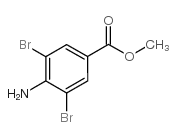
Name: methyl 3,5- dibromo -4- aminobenzoate (alias: methyl 4- amino -3,5- dibromobenzoate, methyl 3,5-dibromoaminobenzoate)
CASNo.: 3282-10-812
Molecular formula: C₈H₇Br₂NO₂, molecular weight 308.95.
2. Storage conditions
Storage conditions: sealed from light and stored at 2-8 C in dry environment.
Fourth, the use
Organic synthesis intermediates: used for the synthesis of drugs and polymer materials.
*The following content is generated by AI and is for reference only.
Methyl 4-Amino-3,5-dibromobenzoate is a specialized organic intermediate characterized by a benzoic acid ester backbone substituted with two bromine atoms at the meta positions and an amino group at the para position relative to the ester functionality. Its molecular formula is C8H7Br2NO2, and it is identified by the CAS Registry Number 106893-78-9. This compound features a distinct chemical architecture that combines the reactivity of the primary amine with the heavy halogenation effects of the dibromo substitution, making it highly valuable in advanced synthetic chemistry.
The primary application of Methyl 4-Amino-3,5-dibromobenzoate lies in the pharmaceutical industry as a critical building block for the synthesis of complex heterocyclic compounds and bioactive molecules. The presence of the amino group allows for versatile derivatization through reactions such as diazotization, acylation, or condensation, while the bromine atoms serve as strategic handles for palladium-catalyzed cross-coupling reactions, including Suzuki-Miyaura and Buchwald-Hartwig couplings. These transformations are essential for constructing diverse molecular scaffolds found in potential drug candidates targeting oncology, infectious diseases, and neurological disorders.
Beyond pharmaceuticals, this intermediate finds utility in the development of functional materials, particularly in the creation of specialized polymers and fluorescent probes where heavy atom effects influence photophysical properties. The electron-withdrawing nature of the bromine substituents modulates the electronic density of the aromatic ring, offering unique tuning capabilities for material scientists designing sensors or optoelectronic components. Due to its specific substitution pattern, it facilitates regioselective synthesis, reducing the need for extensive purification steps often required in multi-step organic pathways.
Handling this substance requires adherence to standard laboratory safety protocols, as with many halogenated amines, though specific toxicity data should be verified via Material Safety Data Sheets (MSDS) before use. It is typically supplied as a high-purity crystalline solid suitable for research and development environments. As the demand for novel therapeutic agents and smart materials grows, derivatives like Methyl 4-Amino-3,5-dibromobenzoate remain indispensable tools for chemists aiming to innovate in molecule design and structural complexity.





 (All Rights Reserved)



![8-Oxa-1,3-diazaspiro[4.5]decane-2,4-dione](https://eimg.pharmasources.com/image/product/20250403/60fa7223d5a34f24138486ceea0ffb15jpg)
![8,16-Diazadispiro[6.1.6.2]heptadecan-17-one](https://eimg.pharmasources.com/image/product/20250403/ca91cba8b87e53fc879f8d8764873a40jpg)
![6,8-Dioxo-5,7-diazaspiro[3.4]octane-2-carboxylic acid](https://eimg.pharmasources.com/image/product/20250403/02effeb5a7639bc84ff1f3add3c0c64fjpg)