Appearance colorless pure liquid
Purity % 98.0 MIN
Moisture% 0.50 MAX
*The following content is generated by AI and is for reference only.
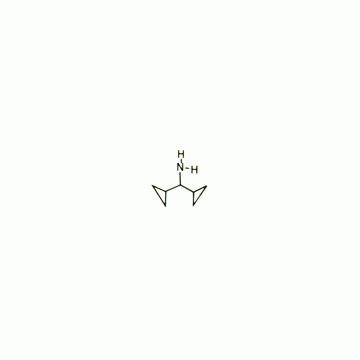
Dicyclopropylmethylamine, chemically known as (dicyclopropyl)methanamine, is a specialized organic amine characterized by the presence of two cyclopropyl rings attached to a central methylene group, which is further bonded to an amino functional group. Its molecular formula is C7H13N, and it is uniquely identified by the CAS number 5406-89-5. This compound serves as a valuable building block in synthetic organic chemistry, particularly for researchers developing complex pharmaceutical intermediates and agrochemicals. The unique structural geometry of the cyclopropyl ring imparts distinct steric and electronic properties to the molecule, often enhancing metabolic stability and binding affinity when incorporated into bioactive molecules.
In industrial applications, Dicyclopropylmethylamine is primarily utilized as a key precursor in the synthesis of heterocyclic compounds and advanced drug candidates. Pharmaceutical companies frequently employ this amine to construct libraries of potential therapeutic agents targeting neurological disorders, cardiovascular conditions, and oncology. The strain inherent in the three-membered rings allows for specific reaction pathways that are not accessible with linear alkyl chains, facilitating the creation of rigid molecular scaffolds essential for high-affinity receptor interactions. Furthermore, its utility extends to materials science, where it may be used to modify polymer surfaces or create specialized ligands for catalytic processes.
Safety protocols are critical when handling this substance, as with many low-molecular-weight amines. It should be stored under inert atmospheres at controlled temperatures to prevent degradation or unwanted polymerization. While not widely available as a bulk commodity chemical, it remains a niche but essential reagent for high-value research laboratories. As the demand for novel therapeutics grows, the role of such structurally unique amines in accelerating drug discovery pipelines becomes increasingly significant. Researchers continue to explore its potential in creating next-generation molecules with improved pharmacokinetic profiles, underscoring its importance in modern chemical innovation.





 (All Rights Reserved)





![5,6,7,7a-Tetrahydro thieno[3,2-c]pyridin-2(4H)-one Hydrochloride](https://eimg.pharmasources.com/img_Cphi_en/Product/2016_02/Mimg_1602021058457992.jpg)