More information, please contact with:
Wang Yili,Tel:86-576-88312598-8687,Phone:13486899703,Email:wangyili@realsunchem.com
*The following content is generated by AI and is for reference only.
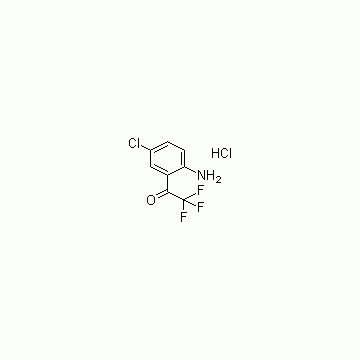
4-Chloro-2-trifluoroacetylaniline hydrochloride is a specialized organic intermediate widely utilized in the pharmaceutical and agrochemical industries for the synthesis of complex heterocyclic compounds. Chemically, this substance features an aniline core substituted with a chlorine atom at the 4-position and a trifluoroacetyl group at the 2-position, existing in its stable hydrochloride salt form to enhance solubility and handling characteristics. Its molecular formula is C8H6ClF3NO·HCl, reflecting the precise stoichiometric composition including the counter-ion. The compound is identified by the CAS number 100975-63-3, which serves as its unique registry identifier in global chemical databases.
The primary application of 4-chloro-2-trifluoroacetylaniline hydrochloride lies in its role as a critical building block for constructing fluorinated drug candidates. The presence of the trifluoroacetyl moiety significantly influences the metabolic stability and lipophilicity of final therapeutic agents, often improving their pharmacokinetic profiles. Consequently, it is frequently employed in the development of anti-inflammatory drugs, antiviral agents, and various kinase inhibitors where precise structural modifications are required. Furthermore, the chlorine substituent provides a versatile handle for subsequent nucleophilic aromatic substitution reactions, allowing chemists to introduce diverse functional groups efficiently during multi-step synthesis pathways.
In terms of physical properties, the hydrochloride salt typically appears as a crystalline solid, offering improved thermal stability compared to its free base counterpart. This characteristic makes it more suitable for storage and transportation under standard laboratory conditions. Researchers must exercise caution when handling this material due to potential irritant properties associated with both the halogenated structure and the acidic nature of the salt. Proper personal protective equipment, including gloves and eye protection, is essential during manipulation. While specific regulatory status may vary by region, the compound is generally classified as a research chemical intended for professional laboratory use rather than direct consumer application. As the demand for fluorinated small molecules grows within the medicinal chemistry sector, derivatives like this continue to gain prominence in process optimization and lead compound generation strategies.





 (All Rights Reserved)






![5,6,7,7a-Tetrahydro thieno[3,2-c]pyridin-2(4H)-one Hydrochloride](https://eimg.pharmasources.com/img_Cphi_en/Product/2016_02/Mimg_1602021058457992.jpg)