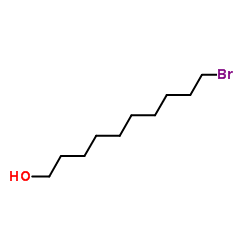
Name: 10- bromo -1- decanol (alias: 10-bromo-n-decanol)
CASNo.: 53463-68-6
Molecular formula: C₁₀H₂₁BrO, molecular weight 237.18.
Appearance: transparent yellow to colorless yellowish liquid
Storage conditions: sealed from light, it is recommended to keep it at-20 C.
use
Intermediates of organic synthesis: used in the synthesis of medicine, surfactant and polymer materials.
Medical field: as the precursor of anti-tumor drugs or other bioactive molecules.
*The following content is generated by AI and is for reference only.
10-Bromodecanol, chemically known as 10-bromo-1-decanol, is a versatile organic intermediate widely utilized in the pharmaceutical and agrochemical industries. With the molecular formula C₁₀H₂₁BrO and a CAS number of 2438-67-5, this compound features a ten-carbon straight chain terminated by both a hydroxyl group and a bromine atom at opposite ends. This unique bifunctional structure makes it an essential building block for synthesizing complex heterocyclic compounds, macrocyclic lactones, and various bioactive molecules.
The primary application of 10-Bromodecanol lies in its role as an alkylating agent. The terminal bromide serves as an excellent leaving group, facilitating nucleophilic substitution reactions to introduce decyl chains into target molecules. Simultaneously, the hydroxyl group allows for further derivatization through esterification or ether formation. In medicinal chemistry, it is frequently employed to construct long-chain analogs that mimic natural fatty acids, which are crucial for developing new antibiotics, antifungal agents, and anti-inflammatory drugs. Furthermore, its utility extends to the production of specialized surfactants and liquid crystals used in advanced material science applications.
From a safety perspective, 10-Bromodecanol should be handled with care as alkyl halides can be irritants and potential mutagens. It is typically stored in a cool, dry place away from strong oxidizing agents and moisture to prevent degradation. While specific industrial protocols vary, standard laboratory safety measures including the use of gloves, goggles, and fume hoods are mandatory during handling. Its relatively high boiling point and solubility in common organic solvents like ethanol, chloroform, and diethyl ether make it convenient for various synthetic procedures. As research into novel drug candidates continues to expand, the demand for high-purity intermediates like 10-Bromodecanol remains steady, supporting innovation across multiple chemical sectors.





 (All Rights Reserved)
![6,8-Dioxo-5,7-diazaspiro[3.4]octane-2-carboxylic acid](https://eimg.pharmasources.com/image/product/20250403/02effeb5a7639bc84ff1f3add3c0c64fjpg)
![8,16-Diazadispiro[6.1.6.2]heptadecan-17-one](https://eimg.pharmasources.com/image/product/20250403/ca91cba8b87e53fc879f8d8764873a40jpg)
![8-Oxa-1,3-diazaspiro[4.5]decane-2,4-dione](https://eimg.pharmasources.com/image/product/20250403/60fa7223d5a34f24138486ceea0ffb15jpg)
