Product Description
Hangzhou Go Top Peptide Biotech Co., Ltd. is a national high-tech enterprise specializing in the research and development and production of peptides and related derivatives. It provides peptide-related custom synthesis and technology for domestic and foreign medical research and development, biotechnology, universities and scientific research institutions service. For consultation or ordering, please contact:86-571-88211951, 86-13588827304 (Cindy Mei), sales19@gotopbio.com
AI Product Description
*The following content is generated by AI and is for reference only.
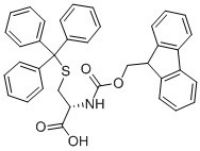
Fmoc-Cys(Trt)-OH, chemically known as N-(9-Fluorenylmethoxycarbonyl)-S-trityl-L-cysteine, is a critical protected amino acid derivative extensively utilized in modern solid-phase peptide synthesis (SPPS). Its molecular formula is C28H27NO4S, and it carries the CAS Registry Number 101659-33-8. This compound serves as a fundamental building block for constructing complex peptides containing cysteine residues, offering high purity and stability during synthetic procedures.
The primary function of Fmoc-Cys(Trt)-OH lies in its dual protection strategy. The fluorenylmethyloxycarbonyl (Fmoc) group protects the alpha-amino functionality, allowing for orthogonal deprotection using mild bases like piperidine without affecting other protecting groups. Simultaneously, the trityl (Trt) group safeguards the thiol side chain of cysteine. This specific side-chain protection is vital because it prevents unwanted disulfide bond formation or oxidation during the repetitive coupling cycles typical of SPPS. Unlike some other protecting groups, the Trt moiety is stable under basic conditions used to remove the Fmoc group but can be selectively cleaved later using acidic cocktails containing trifluoroacetic acid (TFA), often alongside scavengers.
This reagent is indispensable in the pharmaceutical and biotechnology sectors for synthesizing therapeutic peptides, including insulin analogs, hormone mimetics, and various bioactive cyclic peptides where cysteine plays a structural role via disulfide bridges. Researchers favor this product due to its ease of handling, solubility in common organic solvents such as DMF and DCM, and its ability to yield high-purity final products after global deprotection. Its application ensures that the delicate sulfur atom remains intact until the final assembly stage, enabling precise control over peptide folding and biological activity. Consequently, Fmoc-Cys(Trt)-OH remains a staple in research laboratories dedicated to drug discovery, proteomics, and the development of novel peptide-based therapeutics, facilitating the efficient creation of sequences that would otherwise be difficult to synthesize with standard unprotected cysteine derivatives.





 (All Rights Reserved)