Product Description
Assay: not less than 99.0%
AI Product Description
*The following content is generated by AI and is for reference only.
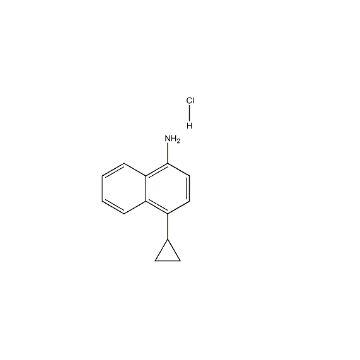
4-Cyclopropylnaphthalen-1-amine hydrochloride is a specialized organic intermediate and research chemical widely utilized in medicinal chemistry and pharmaceutical development. With the molecular formula C₁₃H₁₂ClN, this compound represents a functionalized derivative of naphthalene, featuring a cyclopropyl group at the fourth position and an amine functionality at the first position, stabilized as a hydrochloride salt. While specific CAS registry numbers for this exact stereochemical configuration may vary depending on regional databases or pending registrations, it is generally cataloged under unique identifiers for laboratory supply chains, often appearing in high-purity grades exceeding 98% for analytical and synthetic applications.
The primary utility of 4-cyclopropylnaphthalen-1-amine hydrochloride lies in its role as a critical building block for synthesizing complex heterocyclic systems and bioactive molecules. The strained cyclopropyl ring imparts unique steric and electronic properties to the molecule, which can significantly influence the binding affinity and metabolic stability of drug candidates. Researchers frequently employ this amine salt in nucleophilic substitution reactions, reductive aminations, and coupling processes to construct novel kinase inhibitors, G-protein coupled receptor (GPCR) modulators, and potential anticancer agents. The hydrochloride form ensures enhanced solubility in aqueous media compared to the free base, facilitating easier handling, purification, and storage under standard laboratory conditions.
In the broader context of drug discovery, derivatives containing naphthalene cores are valued for their planar aromatic structures that facilitate pi-stacking interactions within protein binding pockets. By introducing the cyclopropyl moiety, chemists can fine-tune the lipophilicity and conformational rigidity of the scaffold, potentially overcoming resistance mechanisms observed in earlier generations of therapeutics. Although not typically available as a commercial off-the-shelf final drug product, this compound serves as an essential precursor in academic and industrial R&D pipelines. It is strictly intended for research use only, requiring appropriate safety protocols during synthesis due to potential irritant properties associated with aromatic amines and their salts. As the demand for precision medicine grows, such structurally defined intermediates remain indispensable tools for expanding the chemical space available for next-generation pharmaceutical innovation.





 (All Rights Reserved)




![5,6,7,7a-Tetrahydro thieno[3,2-c]pyridin-2(4H)-one Hydrochloride](https://eimg.pharmasources.com/img_Cphi_en/Product/2016_02/Mimg_1602021058457992.jpg)