
On October 12, CDE official website showed that the import application submitted by SciClone Pharmaceuticals for type 5.1 telavancin hydrochloride for injection was accepted.
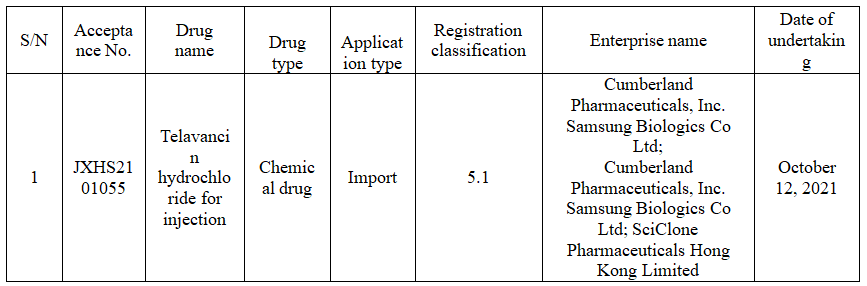
Telavancin (Vibativ) is a kind of glycopeptide antibiotics. It is based on the structure of vancomycin, and is obtained by introducing the fatty chain into the amino group of glycosyl through chemical modification, and introducing the phosphate methylamine methyl group into 7th aromatic amino acid. At present, Vibativ has been approved by FDA to treat complicated skin and skin structure infection (cSSSI) of adults caused by gram-positive bacteria (including methicillin-sensitive staphylococcus aureus (MSSA) and methicillin-resistant (MRSA) strains), and adult hospital-acquired and ventilator-associated bacterial pneumonia (HABP/VABP) caused by staphylococcus aureus.
Vibativ was jointly developed by Theravance and astellas and then being sold to Cumberland Pharmaceuticals by Theravance. In 2015, SciClone Pharmaceuticals reached an agreement with Theravance to obtain the exclusive development and commercialization rights of Vibativ in Greater China (including Chinese mainland, Hong Kong, S.A.R., China, Macau, S.A.R., China and Taiwan, China) and Vietnam.
In addition, telavancin has obtained a granted patent CN100469788 of chemical compound in China and it will expire in 2021. At present, Chiatai Tianqing has laid out the generic drug market of telavancin.
The production application of first second-generation glycopeptide antibiotics in China has been submitted.
Glycopeptide antibiotics, produced by streptomyces or actinomycetes, inhibit the synthesis of bacterial cell walls by combining with the tail of aminoacyl-D alanyl-D alanine of bacterial N-acetyl muramic acid pentapeptide, thus killing the bacterial. Therefore, they are widely used to treat infectious diseases caused by Gram-positive bacteria.
At present, many glycopeptide antibiotics have been approved globally, such as vancomycin, norvancomycin, teicoplanin, dalbavancin, oritavancin and telavancin. Vancomycin, norvancomycin and teicoplanin are the first generation of glycopeptide antibiotics, while dalbavancin, oritavancin and telavancin are the second generation of glycopeptide antibiotics.
Vancomycin is the first glycopeptide antibiotics in the world, which can not only inhibit the synthesis of bacterial cell wall, but also change the permeability of bacterial cell membrane and hinder the synthesis of bacterial RNA. In addition, it has a strong bactericidal effect on gram-positive bacteria such as staphylococcus aureus, staphylococcus epidermidis, streptococcus pyogenes, streptococcus pneumoniae, streptococcus viridans and most of enterococci.
Teicoplanin is a new glycopeptide antibiotics similar to vancomycin. Compared with vancomycin, teicoplanin is easier to penetrate in tissues and cells with more fatty acid side chains, which improves lipophilicity.
Dalbavancin is obtained by introducing 3- (dimethylamino)-1-propylamine into the C-terminal carboxyl of the structure of teicoplanin analogue A40926 by chemical method. It is similar to the active mechanism of natural glycopeptide antibiotics, but its biological activity is obviously enhanced. Dalbavancin (trade name: Dalvance) was originally discovered by Vicuron Pharmaceuticals (later acquired by Pfizer). Later, it was sold to Durata by Pfizer. In May 2014, it was approved by FDA to treat adult patients with acute bacterial skin and skin structural infection (ABSSSI) caused by Gram-positive bacteria (including methicillin-resistant staphylococcus aureus, MRSA), and in July this year, it was approved by FDA to treat pediatric patients with ABSSSI caused by Gram-positive bacteria (including MRSA). It is reported that the global sales of Dalvance reached 87.9 million US dollars in 2019.
Oritavancin is a structural derivative modified with 4'-chlorobiphenyl methyl on the amino group of 4-amino acid disaccharide of chloroorient toxin A. The introduction of modified side chain groups on its glycosyl promotes the anchoring with the cell membrane of targeted st...
























 (All Rights Reserved)