Product Description
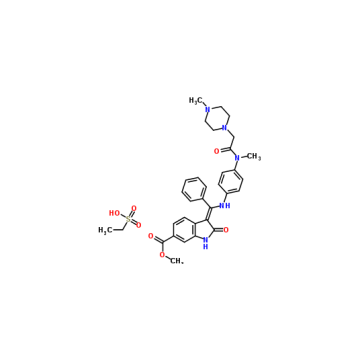
- 英文名称: Nintedanib esylate
- 别名: 尼达尼布乙磺酸盐; (3Z)-2,3-二氢-3-[[[4-[甲基[2-(4-甲基-1-哌嗪基)乙酰]氨基]苯基]氨基]苯亚甲基]-2-氧代-1H-吲哚-6-甲酸甲酯乙磺酸盐;
- CAS号: 656247-18-6
- 分子式: C33H39N5O7S
- 分子量: 649.75700
AI Product Description
*The following content is generated by AI and is for reference only.
Nintedanib esylate is a potent, small-molecule tyrosine kinase inhibitor (TKI) developed primarily for the treatment of fibrotic lung diseases and certain types of cancer. It serves as the mesylate salt form of nintedanib, designed to enhance solubility and stability for pharmaceutical formulation. The molecular formula of nintedanib esylate is C29H35N7O4S2, with a corresponding CAS number of 1360899-98-6. This chemical entity acts by simultaneously inhibiting multiple receptor tyrosine kinases, including vascular endothelial growth factor receptors (VEGFR), platelet-derived growth factor receptors (PDGFR), and fibroblast growth factor receptors (FGFR). By blocking these signaling pathways, the drug effectively disrupts the proliferation and migration of fibroblasts and smooth muscle cells, thereby slowing the progression of tissue scarring.
Clinically, Nintedanib esylate has gained significant approval for treating idiopathic pulmonary fibrosis (IPF) in adults, as well as chronic fibrosing interstitial lung diseases with a progressive phenotype. Its mechanism targets the underlying pathophysiology of fibrosis rather than just symptoms, making it a disease-modifying therapy. Beyond respiratory applications, research indicates its potential utility in oncology, particularly for non-small cell lung cancer (NSCLC) when combined with chemotherapy regimens, due to its anti-angiogenic properties that starve tumors of blood supply. The drug is typically administered orally in capsule form, requiring careful monitoring for gastrointestinal side effects such as diarrhea, which is the most common adverse reaction.
The development of the esylate salt was crucial for optimizing the pharmacokinetic profile of the active moiety, ensuring consistent bioavailability in patients. As a multi-targeted TKI, it represents a significant advancement in therapeutic strategies against complex fibrotic processes where single-pathway inhibitors often fail. Ongoing studies continue to explore its efficacy in other fibrotic conditions and combination therapies. While generally well-tolerated, dose adjustments may be necessary based on individual patient response and tolerability. Overall, Nintedanib esylate stands as a critical tool in modern medicine for managing debilitating fibrotic disorders and certain malignancies, offering hope for improved quality of life and survival rates for affected populations.





 (All Rights Reserved)

![4-[[[[6-[(Diethylamino)methyl]-2-naphthalenylmethoxy]carbonyllaminolbenzoic acid](https://eimg.pharmasources.com/image/20241206/xJCFsdgfMrHzqjtgeOixhGQHgVbKi7kAcoEqemzE.jpg)