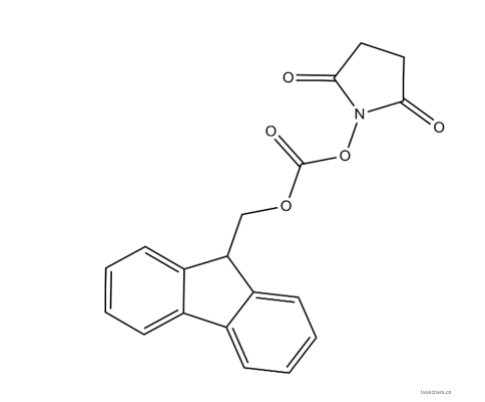
Name: Fmoc osu9 fluorene - methyl - N - succinimide base carbonate nickname: N - (9 - oxygen carbonyl oxygen fluorene armor) succinimide.
9 - fluorene methyl succinyl imino - carbonate;
Fluorene methoxyl carbonyl acyl succinimide;
N - (9 - Fluorenylmethoxycarbonyloxy) succinimide;
(2, 5 - dioxopyrrolidin - 1 - yl) 9 h - fluoren - 9 - ylmethyl carbonateCAS: 82911-69-1 formula: C19H15NO5 molecular weight: 337.32
*The following content is generated by AI and is for reference only.
N-(9-Fluorenylmethoxycarbonyloxy) is a specialized chemical intermediate primarily utilized in the field of organic synthesis and peptide chemistry. Often associated with the Fmoc protecting group strategy, this compound serves as a crucial reagent for the temporary protection of amino groups during the solid-phase peptide synthesis (SPPS) process. The molecule features a fluorenylmethoxycarbonyl moiety linked to an oxygen atom, which allows for selective attachment to nucleophilic sites such as amines or hydroxyls under mild conditions. Its distinct structural architecture ensures high stability against acidic conditions while remaining susceptible to removal via treatment with weak bases like piperidine, making it indispensable for stepwise peptide assembly without causing racemization or side reactions.
The specific CAS registry number for this compound varies depending on the exact counter-ion or specific derivative form, but it is fundamentally derived from 9-fluorenylmethyl chloroformate (Fmoc-Cl). In commercial applications, it is frequently employed to synthesize Fmoc-protected amino acids, which are the building blocks for producing complex therapeutic peptides, hormones, and bioactive molecules. The utility of N-(9-Fluorenylmethoxycarbonyloxy) extends beyond simple protection; it facilitates the creation of orthogonal protection schemes where multiple functional groups can be manipulated independently. This capability is vital for synthesizing long-chain polypeptides with precise sequences required for pharmaceutical research and development.
Furthermore, the reagent plays a significant role in material science, particularly in the development of self-healing polymers and smart materials that rely on reversible covalent bonding mechanisms. The ease of deprotection allows for efficient purification processes, enhancing overall yield and purity in laboratory settings. Researchers worldwide rely on its consistent performance to ensure reproducibility in experiments involving protein engineering and drug discovery. As the demand for biopharmaceuticals grows, the importance of high-quality Fmoc-based reagents like this one continues to expand. It remains a staple in modern synthetic laboratories, bridging the gap between theoretical organic chemistry and practical industrial application. Whether used for academic research or large-scale manufacturing, this compound exemplifies the precision and efficiency inherent in contemporary protective group chemistry.





 (All Rights Reserved)

![8-Oxa-1,3-diazaspiro[4.5]decane-2,4-dione](https://eimg.pharmasources.com/image/product/20250403/60fa7223d5a34f24138486ceea0ffb15jpg)
![6,8-Dioxo-5,7-diazaspiro[3.4]octane-2-carboxylic acid](https://eimg.pharmasources.com/image/product/20250403/02effeb5a7639bc84ff1f3add3c0c64fjpg)
![8,16-Diazadispiro[6.1.6.2]heptadecan-17-one](https://eimg.pharmasources.com/image/product/20250403/ca91cba8b87e53fc879f8d8764873a40jpg)