Product Description
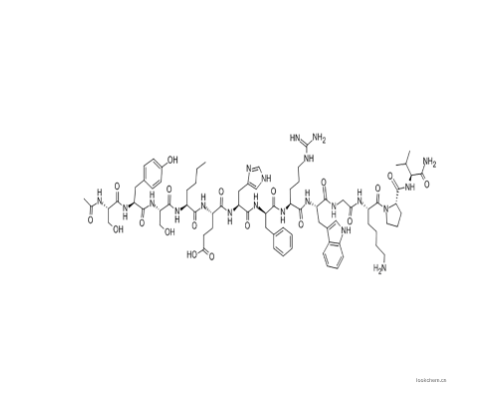
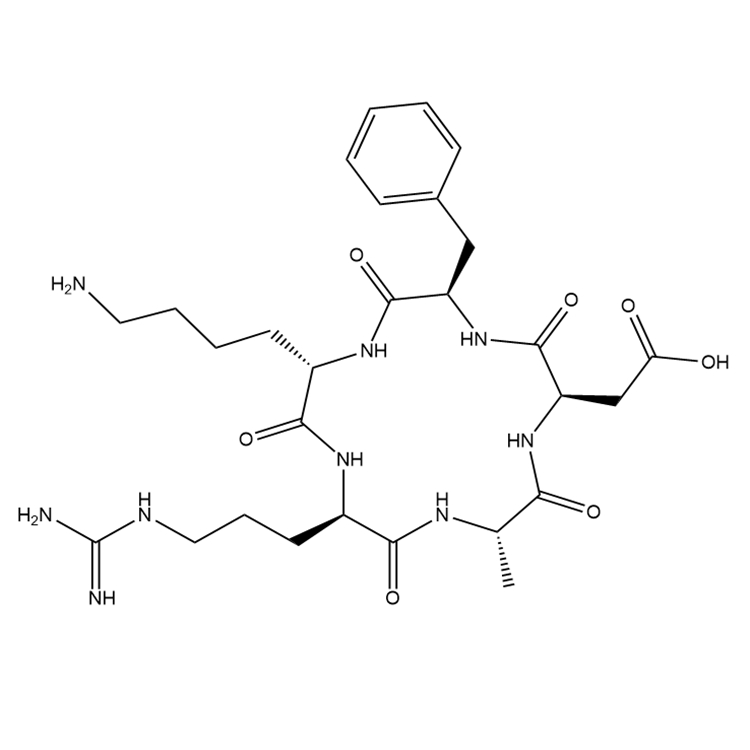
Cyclo (RADfK) is a selective α(v)β(3) integrin ligand peptide, a peptide composed of 5 amino acids, and has a cyclic structure, which has strong stability and a long half-life. Now Cyclo (RADfK) is widely used in research related to neovascularization.
AI Product Description
*The following content is generated by AI and is for reference only.
Cyclo(RADfK), chemically designated as Cyclo(Arg-Ala-Asp-Phe-Lys) or often referred to in specific research contexts involving cyclic peptides with this sequence, represents a sophisticated molecule within the realm of bioactive peptide therapeutics. Its molecular structure consists of five amino acid residues—Arginine, Alanine, Aspartic Acid, Phenylalanine, and Lysine—arranged in a closed loop configuration. This cyclic topology is crucial as it confers significant metabolic stability compared to linear counterparts, protecting the peptide from rapid degradation by proteolytic enzymes in biological systems. While exact commercial catalog numbers and CAS registry identifiers can vary depending on the specific supplier, purity grade, or synthetic modification (such as isotopic labeling or side-chain protection groups), standard forms are typically sought after for their unique pharmacological properties.
The primary application of Cyclo(RADfK) lies in advanced biomedical research, particularly in the fields of oncology and tissue engineering. The inclusion of the RGD-like motif (often associated with Arg-Gly-Asp sequences, though here modified) suggests potential interactions with integrin receptors on cell surfaces, facilitating cell adhesion, migration, and signaling pathways essential for wound healing and angiogenesis. Researchers utilize this cyclic peptide to investigate tumor metastasis mechanisms, develop targeted drug delivery vehicles, or engineer biomaterials that mimic the extracellular matrix. Its ability to modulate cellular behavior makes it a valuable tool for screening novel therapeutic agents against cancer cells or promoting regeneration in damaged tissues. Furthermore, due to its specific conformational rigidity, it serves as an excellent model for studying structure-activity relationships in peptide design. Although not yet widely approved as a standalone clinical drug, it remains a critical reagent in preclinical studies aimed at understanding complex biological interactions. Scientists leverage its unique chemical architecture to probe receptor binding affinities and optimize peptide-based drugs for enhanced efficacy and reduced toxicity. As the demand for precision medicine grows, such tailored cyclic peptides continue to play an pivotal role in bridging the gap between fundamental biochemical research and clinical innovation, offering promising avenues for next-generation treatments.





 (All Rights Reserved)