Product Description
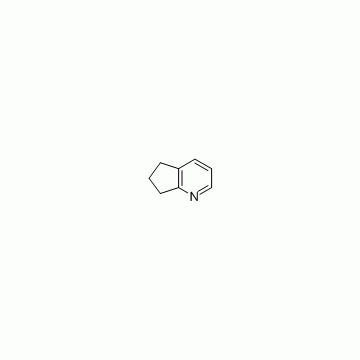
Molecular formula: C8H7N Molecular weight: 117.15 Density: 1.018g/cm3at 25 °C Boiling point: 212.2 °C at 760 mmHg Refractive index: n20/D 1.544 Flashing point: 67 ºC Appearance: A clear, colourless to pale yellow colour liquid. Application : Cefepime intermediate
AI Product Description
*The following content is generated by AI and is for reference only.
2,3-Cyclopentapyridine is a fused heterocyclic compound belonging to the class of nitrogen-containing aromatic systems. Its molecular formula is C8H7N, and it carries the CAS registry number 1009-53-6. Structurally, this molecule consists of a pyridine ring fused with a cyclopentene ring at the 2,3 positions, creating a rigid, planar framework that exhibits unique electronic properties due to the interaction between the pyrrolic and pyridinic nitrogen atoms. This specific fusion alters the electron density distribution compared to its parent rings, making it a valuable scaffold in medicinal chemistry and materials science research.
In terms of applications, 2,3-cyclopentapyridine serves primarily as a versatile intermediate in the synthesis of complex pharmaceutical agents and agrochemicals. Researchers utilize its structural rigidity to design ligands for metal coordination complexes, which are essential in catalysis and the development of luminescent materials. The presence of the nitrogen atom within the aromatic system allows for various derivatization reactions, including alkylation, acylation, and nucleophilic substitution, facilitating the creation of diverse analogs with tailored biological activities. Consequently, it plays a crucial role in drug discovery programs targeting neurological disorders, anti-inflammatory conditions, and antimicrobial infections.
Furthermore, this compound is frequently employed in academic studies investigating the structure-activity relationships (SAR) of heterocyclic systems. Its stability under standard laboratory conditions makes it suitable for long-term storage and handling, while its distinct spectroscopic signatures aid in analytical characterization. While not yet a mainstream commodity chemical, 2,3-cyclopentapyridine remains an important building block for advanced organic synthesis. Scientists continue to explore its potential in developing novel functional materials, such as organic semiconductors and fluorescent probes, owing to its conjugated pi-system. As the demand for precision medicine and high-performance materials grows, the utility of such specialized heterocycles is expected to expand significantly. Overall, 2,3-cyclopentapyridine represents a significant asset in the toolkit of modern chemists, bridging the gap between fundamental heterocyclic theory and practical industrial application through its unique reactivity and structural versatility.




 (All Rights Reserved)
![5,6,7,7a-Tetrahydro thieno[3,2-c]pyridin-2(4H)-one Hydrochloride](https://eimg.pharmasources.com/img_Cphi_en/Product/2016_02/Mimg_1602021058457992.jpg)