
Topical Janus kinase (JAK) inhibitors are becoming a major force in atopic dermatitis (AD) space. An increasing number of JAK agents are filling the early and late-stage pipeline, says GlobalData. The company notes that, of the 98 pipeline agents, eight are JAKs – with six of these being topical formulations.
Ramla Salad, Pharma Analyst at GlobalData, comments “JAK inhibitors can combat AD at the immune system level due to their broad inhibitory effect. They are being developed in both oral and topical formulations, which target both mild-to-moderate and moderate-to-severe respectively. Thus, targeting an array of patient groups; younger patients will be able to tolerate the topical agents more especially for mild-to-moderate leading to better compliance. There may be a relatively small amount of JAKs on the market now but JAKs are set to revolutionise the AD space.”
GlobalData highlights some of the top players in this space: JAK inhibitors can help combat AD at the immune system level and, according to Dr Simpson, they may be able to do so more broadly than a targeted biologic can, given their ability to inhibit the effects of several cytokines.
Incyte’s ruxolitinib – Strong-efficacy player shows confidence as it targets new patient pool before receiving approval

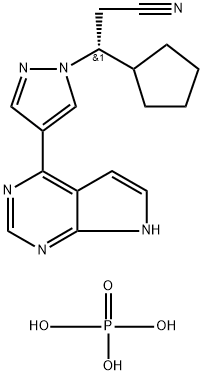
Incyte leads the pack with its JAK1/2 inhibitor, ruxolitinib – which is already marketed as Jakafi, an oral formulation for the treatment of myelofibrosis
Salad continues, “Not only did this drug show strong efficacy in its Phase III TRuE-AD2 trial*, but Incyte has confidently registered a second Phase III trial (TRuE-AD3) assessing efficacy and safety of ruxolitinib in children aged 2–12. This move shows that the company is anticipating approval in adults, and is looking to greatly expand its market potential by targeting pediatric patients. Rival Pfizer used a similar tactic with its topical PDE4 inhibitor, Eucrisa (crisaborole).”
LEO Pharma’s delgocitinib – Fast Track Designation (FTD) will help expedite the regulatory process
Ruxolitinib’s closest competitor is LEO Pharma’s delgocitinib, a topical pan-JAK inhibitor tailored towards patients suffering from chronic hand eczema (CHE). Delgocitinib’s Phase IIb** data showed off a dose-dependent response to twice-daily doses of 8mg/g and 20mg/g, demonstrating the highest efficacy in adults with mild-to-severe CHE. By week 16 of treatment, nearly 40% of patients receiving either dose were clear or almost clear of symptoms as assessed by IGA-CHE. This is promising, as symptoms in CHE typically persist for at least three months.
Salad continues, “GlobalData notes that, although delgocitinib will likely be second-to-market behind ruxolitinib, delgocitinib’s FDA fast-track designation (FTD), awarded in Q3 2020, will help to expedite the regulatory process. Delgocitinib is already approved in Japan under the name Corectim for adult and more recently pediatric patients with AD. Japanese approval of this agent in both age groups suggests the drug has a solid efficacy and safety profile.”
Aclaris Therapeutics’ ATI-1777 – emollient spray administration to differentiate ATI-1777 from competitors in CHE space
Aclaris Therapeutics recently announced positive preliminary Phase IIa data for its JAK 1/3 inhibitor, ATI-1777, in the treatment of CHE. These data will support the initiation of the company’s planned Phase IIb trial.
Salad adds, “By targeting CHE, both ATI-1777 and delgocitinib are focusing on a unique patient population with great unmet need. If efficacious, these types of agents will likely take precedence over existing therapies due to the localization of treatment. In contrast to delgocitinib, ATI-1777 is being developed as an emollient spray, which will likely help to differentiate the product.”
The rest of the pipeline
The remaining topical JAK inhibitor agents in the pipeline for AD are in earlier stages of development but each shows unique promise.
S...


































 (All Rights Reserved)