
How time flies! I’ve obtained the statistics of the top 10 pharmaceutical products by sales in 2019H1 after organizing the financial reports of the companies. Please see the following table (sales of Eylea are converted into USD according to the exchange rate when the related statement was released). Adalimumab is expected to continue to top the list of pharmaceutical products by sales based on its sales in 2019H1, while, the 2019H1 sales of etanercept of which the sales ranked fifth in 2018 were eye-popping to reach only USD2.965 billion and the drug may not be among the top 10 pharmaceutical products by sales this year (Editor's Note: this year=2019, same as below). Here, I'd like to successively analyze the pharmaceutical products in the following table.
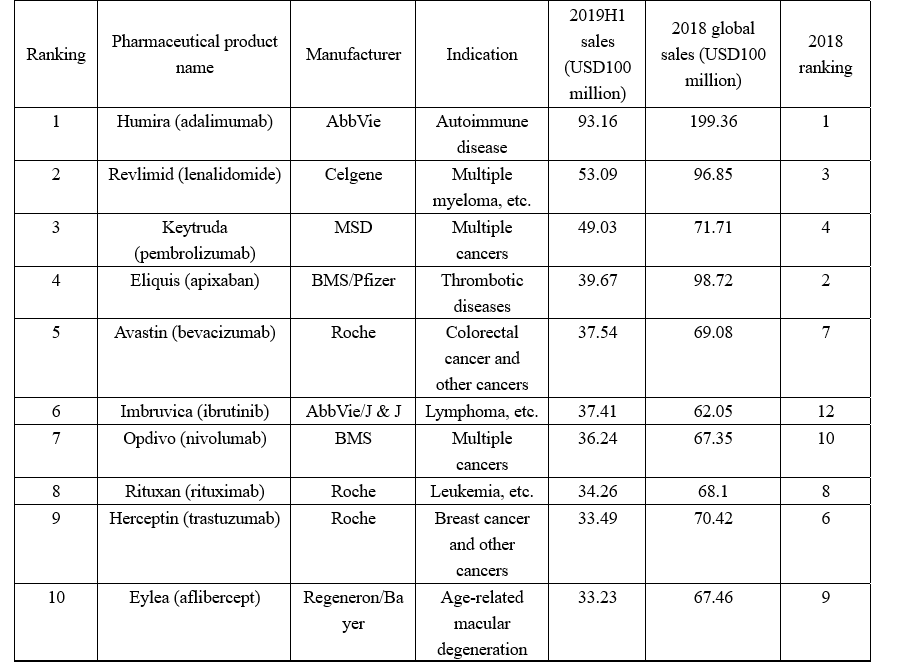
Developed by AbbVie, Humira (adalimumab) is the first fully human anti-TNF-α monoclonal antibody approved by the FDA. It was marketed in the U.S. in 2002, the EU region in 2003 and China in 2010 and has so far been approved for more than 10 indications. Humira‘s sales have been soaring since it was marketed, and it has topped the list of global pharmaceutical products by sales for years. However, the annual growth of Humira‘s sales has been slower than previous years with the patent expiration and the marketing of multiple biosimilars. Yet, its sales still far exceed the sales of the pharmaceutical product ranking second. But the hope that its annual sales will exceed USD20 billion might evaporate into a dream. It is worth mentioning that Humira has been reduced its price in China to cope with the impacts from generic drugs, and the first adalimumab similar--Bio-Thera‘s QLETLI has been approved by the NMPA for marketing at the beginning of this November, which is expected to be a tremendous impact to Humira in the future.
Revlimid (lenalidomide) is a new-generation immunomodulatory drug characterized by immunoregulation, anti-angiogenesis, and anti-tumor. Clinically, it is extensively used to treat multiple myeloma, lymphoma, myelodysplastic syndrome, and acute myelogenous leukemia, etc., being a drug commonly used in the world and China for multiple myeloma and myelodysplastic syndrome. Developed by Celgene, the original drug of lenalidomide was first approved for marketing in the U.S. in 2005 and approved in China in 2013. The annual sales of lenalidomide have been growing at a sustained and stable pace since it was marketed, and it has been the core product of Celgene over the years. Its global sales reached as high as USD9.685 billion in 2018, accounting for 63.4% of the annual revenue of Celgene. The annual sales of lenalidomide are expected to exceed USD10 billion in the future with the successful approval for indolent lymphoma and other indications. Enterprises have started to lay out the area given the huge market potential of lenalidomide. There have been two lenalidomide generic drugs approved in China, separately SL Pharm‘s Lisheng and Chia Tai Tianqing‘s Anxian. Furthermore, Jiangsu Hansoh, Yangtze River Pharmaceutical, and Qilu Pharmaceutical are also working on the approval of their lenalidomide generic drugs. However, it is learned that some patents of lenalidomide will not expire until 2027, which means that its market share will not be shaken before 2022.

As one of the anti-PD-1/PD-L1 monoclonal antibodies, an R&D hotspot in recent years, Keytruda (pembrolizumab) was first approved for marketing in the U.S. in Oct. 2015 and approved for marketing in China in July 2018. Marketed later than Opdivo, yet Keytruda has surpassed the latter to become the anti-PD-1 monoclonal antibody with the most extensive indications approved, and its sales surpassed Opdivo‘s sales in 2018 to rank fourth. Keytruda was approved by the FDA to treat esophagus cancer this July, while, the two pivotal Phase III clinical trials CheckMate-498 and CheckMate-459 of Opvido failed, therefore, Keytruda is expected to be the stable leader in the anti-PD-(L)1 monoclonal antibody area.
Eliquis is an oral, selective factor Xa inhibitor and the only oral anticoagulant that has performed better in risk reduction than warfarin i...
























 (All Rights Reserved)