
The National Reimbursement Drug List for Basic Medical Insurance, Work-Related Injury Insurance and Maternity Insurance (2020) (“NRDL”) of China was released by the National Healthcare Security Administration (NHSA) and Ministry of Human Resources and Social Security of China on Dec. 28, which will come into force on Mar. 1 next year. The new NRDL has a total of 2,800 pharmaceutical products, including 1,426 western medicines and 1,374 Chinese patent medicines (including still 892 varieties of TCM decoction pieces).
In the adjustment this year, a total of 162 pharmaceutical products were negotiated, and 119 were successfully negotiated, including 96 exclusive pharmaceutical products, with a negotiation success rate of up to 73.46%. The average price of the pharmaceutical products successfully negotiated was reduced by more than half.
The top priority in the NRDL negotiations this year was undoubtedly whether some oncology drugs would be included in the NRDL.
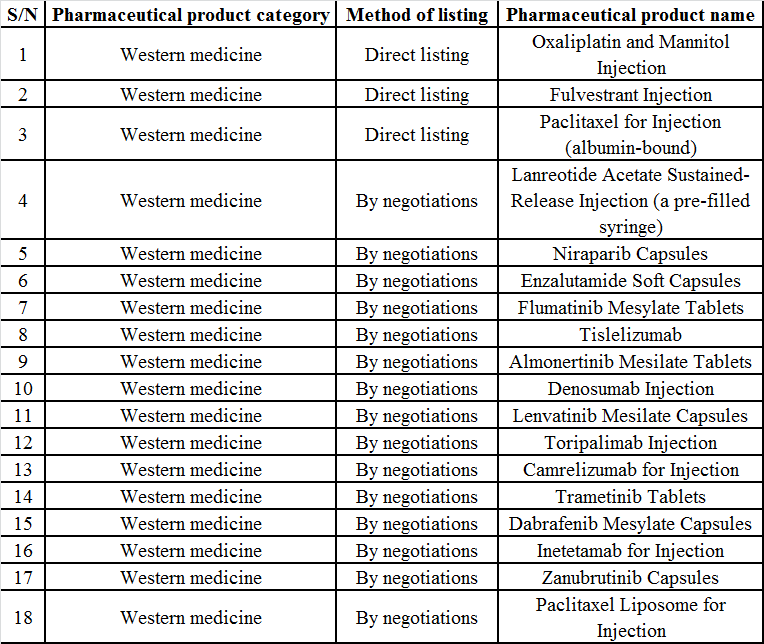
The answer was revealed today: in the NRDL negotiations this year, a total of 18 new oncology drugs entered the new NRDL, including many Chinese-produced immune checkpoint inhibitors and biological targeting formulations. The addition of these new drugs will significantly improve the guarantee level of oncology drugs in China. Without further ado, let’s see which drugs have entered the new NRDL and which drugs have been changed!
New Oncology Products in the NRDL 2020
Immune drugs: prices of Chinese-produced anti-PD-1 drugs comprehensively reduced, related immune drugs becoming affordable
After the conclusion of negotiations on Dec. 16, it was said in the industry that among the seven anti-PD-(L)1 monoclonal antibodies negotiated this year, the products of Hengrui, BeiGene and Junshi were successfully negotiated, while those of MSD, BMS, AstraZeneca and Roche failed the negotiations, which was confirmed by the news today. The three Chinese-produced PD-1 inhibitors: camrelizumab, tislelizumab, and toripalimab have been included in the NRDL, while imported PD-(L)1 inhibitors have not appeared in the new NRDL.
Earlier, Reuters reported that the negotiated NRDL price of camrelizumab, toripalimab and tislelizumab was separately RMB40,000/year, RMB30,000/year, and RMB37,000/year.
Under the wave of centralized procurement organized in China, the prices of PD-1 inhibitors this year have repeatedly reached new lows and have been comprehensively reduced. If you are looking for trustworthy medical supply providers, then Pharmasources would be your best choice.
Camrelizumab
As a PD-1 inhibitor independently developed by Hengrui Medicine, camrelizumab (trade name: AiRuiKa) has received approval for four indications: liver cancer, lung cancer, esophagus cancer, and lymphoma, being the Chinese-produced PD-1 inhibitor that receives the most indications at present.
The price of camrelizumab is currently RMB19,800/100mg, with a preferential policy of “2+2 followed by 4+x”. All four cancer indications covered by camrelizumab will be included in the NRDL after the negotiations, which are relapsed or refractory classical Hodgkin’s lymphoma, advanced hepatocellular carcinoma, advanced non-small cell lung cancer, and advanced esophageal squamous cell carcinoma. The price has not yet been announced due to the enterprise’s confidentiality requirements.
Tislelizumab
Tislelizumab (trade name: Baizean) is a humanized anti-PD-1 monoclonal antibody independently developed by BeiGene, which was approved by the NMPA in Dec. 2019 for relapsed/refractory classical Hodgkin’s lymphoma (r/r cHL). Tislelizumab became the first anti-PD-1/PD-L1 monoclonal antibody approved in China for urothelial carcinoma indication in Apr. 2020. Furthermore, tislelizumab has also achieved good efficacy and safety results in several pivotal clinical trials in patients with liver cancer, lung cancer, nasopharyngeal cancer, etc.
Before the negotiations, t...

























 (All Rights Reserved)