

Prologue
Spray drying, an innovation in the development and manufacturing field has been gaining importance over the last few years, as an increasing number of drug products have been getting approved by regulators over the world and reaching the market. This series of two article on this topic reviews this important topic.
The first article provides an outline of the issue of poor solubility and bioavailability, how spray drying has been addressing this critical issue, typical spray drying process and application of spray drying from an early to late phase of product development.
The second article in the series on spray drying would address some of the practical considerations in application of spray drying to later phases of development, proprietary platforms in the industry, some products which have been commercialized for small molecules as well as application of spray drying to protein products, challenges and some products which have been commercialized for proteins.
Around 50% of drugs on the market and nearly 90% of molecules in the discovery pipeline are estimated to be poorly water soluble. An increasing number of new chemical entities (NCEs) with poor physical, chemical, and biopharmaceutical properties are contributing to high failure rates due to efficacy issues. A key factor has been poor solubility leading to low bioavailability, resulting in suboptimal drug delivery, ineffective drug efficacy, and side effects.
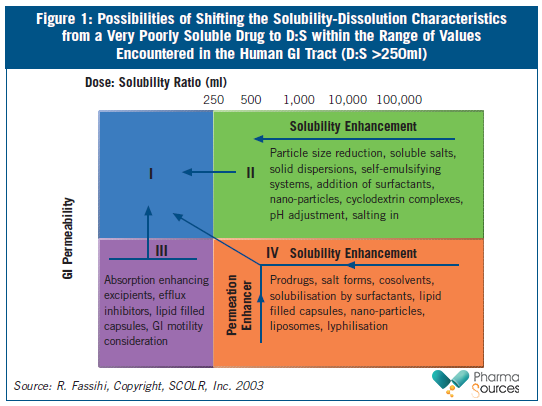
The Biopharmaceutical Classification System (BCS) classifies poorly soluble compounds as Class II (poor solubility and high permeability) and Class IV drugs (poor solubility and poor permeability). Drug substances are considered highly soluble when the largest dose of a compound is soluble in <250ml of water over a pH range of 1-7.5. Highly permeable compounds are classified as those compounds that demonstrate over 90 per cent absorption of the administered dose. Compounds with solubilities below 0.1mg/mL face significant solubilization obstacles, and sometimes even compounds with solubilities below 10mg/mL present difficulties related to solubilization during formulation. Figure 1 summarizes various approaches used to shift the solubility characteristics of a poorly soluble drug.
In 2010, the Developability Classification System (DCS) was proposed by J. Dressman1. The DCS was designed to close the gap between the biopharmaceutics classification system, which is aimed at guiding regulatory decisions about well-characterized drugs, and the need for early evaluation of drug candidates with respect to their suitability for oral delivery. In this classification, drugs are partitioned into four classes based on their jejunal permeability and the volume of simulated intestinal fluid needed to dissolve an entire single dose.
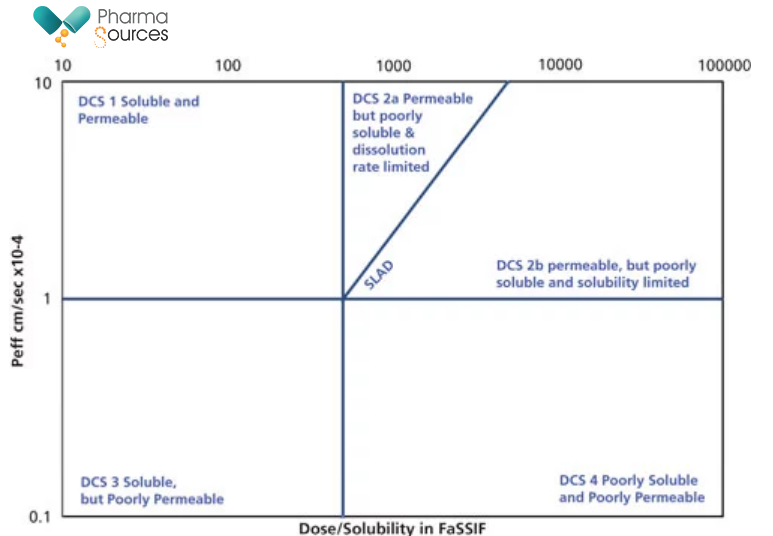
Fig 2: Developability Classification System (DCS) classification chart.
(Source: Pharmaceutical Technology-04-02-2018, Volume 42, Issue 4, Pages: 72–77.)
DCS calculates the solubility limited absorbable dose (SLAD), above which no more drug is expected to dissolve during the transit time through the small intestine, and this is used to split DCS Class II into molecules with dissolution rate limitations (DCS Class IIa) and solubility limitations (DCS Class IIb) to oral absorption. Here, it is important to remember that dose means the maximum dose taken by a patient at one time (not the highest strength dosage unit)...

























 (All Rights Reserved)