

ABSTRACT: This article, which is Part 2 of the series on address some of the practical considerations in application of spray drying to later phases of development, proprietary platforms in the industry, some products which have been commercialized for small molecules as well as application of spray drying to protein products, challenges and some products which have been commercialized for proteins.
Application of spray drying to later phases of development
The importance of using a QbD approach throughout an SDD product's life cycle, from development to validation, is critical owing to spray drying's multidimensional nature. The International Conference on Harmonization (ICH) defines QbD1 as "A systematic approach to development that begins with predefined objectives and emphasizes product and process understanding and process control, based on sound science and quality risk management." A QbD approach to spray-drying process development starts with defining objective, which is the Target Product Profile (TPP) to ensure the safety and efficacy of the drug product. 1 The next step is to understand the relationships between ASD Critical Quality Attributes (CQAs) and Critical Process Parameters (CPPs) in the spray drying process so that a robust control strategy can be developed, drawing upon past product and process experience. Table 1 below lists the commonly identified CPPs for the spray drying process and their general impacts on CQAs 2,3,4,5,6,7.
Table 1: CPP's in spray drying and their impact on CQA's.
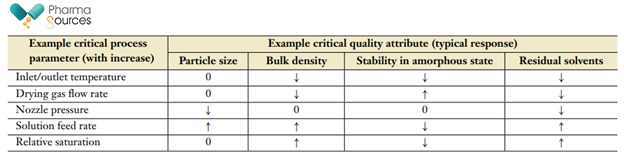
The examples shown in Table 1 may vary depending on the spray-drying process for each product however, understanding these interrelationships lays the groundwork for a successful control strategy. While applying QBD approach, the best approach is the development of an appropriate design space which can be used to define the multidimensional interaction of variables and parameters to demonstrate assurance of quality1
Development of an accurate design space for spray-drying process scale-up is vitally important. Maintaining physical stability of the amorphous form while producing materials that are amenable to robust manufacturing and performance of the dosage form process is critical.
Changes in manufacturing equipment at larger scale (e.g., nozzle size, chamber size, cyclone efficiency), shifts in thermodynamics (e.g., process temperatures), and differences in particle dynamics make fundamental understanding of these scale factors and functional product/process relationships key.
Spray-drying process and product functional relationships can be related through scale independent factors and/or fundamental models in key areas such as drying and thermodynamics or atomization and particle formulation 2,7
Use of Proprietary platforms in manufacture of ASD's using spray drying
Several proprietary platforms have been used for both development as well as for commercialization purposes.8
The Hovione Intelligent Proprietary Screening methodology for ASDs (ASD-HIPROS®) was launched in January 2021 and is offered from the company's Lisbon, Portugal, R&D center (1). The service aims at developing ASDs formulations with maximum stability and performance by eliminating inviable candidates, thus saving the time and investment needed to bring the drug to the patient. Hovione claims that this proprietary process can assess up to 24 formulation prototypes in six weeks, requiring as little as five grams of API.
ZERION, a Danish drug development company established in 2019 as a spinout from the University of Copenhagen has pioneered the Dispersome® technology 9 that greatly enhances the solubility of poorly soluble, oral drugs and improves bioavailability and therapeutic outcomes for the patients. It is based on preparin...
























 (All Rights Reserved)