

The process of taking a new drug from concept to clinic and eventually to commercialization involves several steps which traditionally occur in series. The average development timeline from discovery stage to commercialization today takes anywhere from 10 and 14 years with costs more than $1 billion.1,2 with a success rate of only one in 10000 discovery compounds reaching the market. Change from sequential to overlapping value chain to reduce cycle times would benefit the pharmaceutical industry tremendously. Increasingly, in-vivo studies are conducted in parallel. Failing faster and cheaper is becoming increasingly important for the pharmaceutical industry! This can be helped in no mean measure by application of rational formulation development.
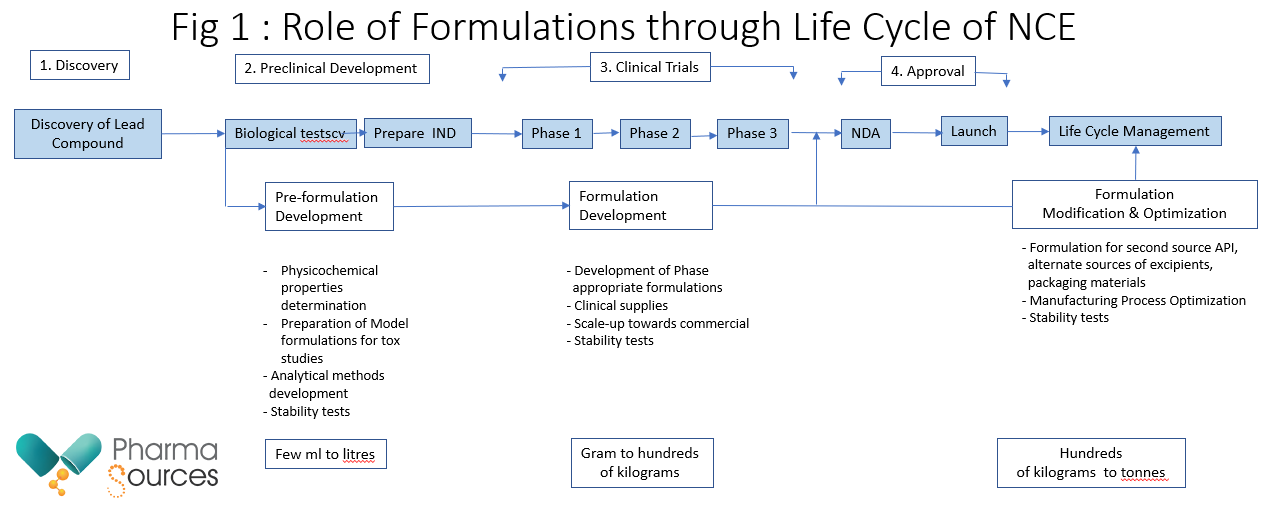
Formulations span the whole life cycle of NCE spectrum from discovery to commercialization and beyond as shown in Fig 1.
Pre-formulation Studies
Pre-formulation studies are highly important to characterize new molecules and forms the basis for starting any formulation effort. It helps in understanding the critical properties of the NCE and its fault lines that need to be overcome by the formulation process. Among the key properties of the Active Pharmaceutical Ingredient (API) to be characterized include melting point, microscopy, solubility (pH 1.2, pH 7.4), Log P, pKa, permeability, chemical stability, particle size distribution, microscopy, density, solubility (pH range1–8, biorelevant dissolution media), Log P, wettability, flow properties, compression properties, excipients compatibility and hygroscopicity. As different polymorphic forms could co-exist for the same NCE, it is very important to identify a stable polymorphic form and make sure that the same form is used during the different stages of drug development, so that adequate exposure can be maintained.
Different Phases in Formulation Development
Phase 1 involves API characterization including particle size, flow properties and other critical physical characteristics, development of prototype formulations, selection of excipients and definition of ratios versus API. Thus, the goal is to define a formulation.
Phase II involves scale-up to appropriate scale and optimization of both formulation and manufacturing process. This the goal is to finalize quantitative formulation including in-process tests and release specifications
Phase III involves scale up to pivotal batch scale, up to 10% of commercial batch size (or 100,000 units), finalization of the manufacturing process, use of validated analytical methods and manufacture of registration stability batches using the API with the final synthetic process and batch size for supporting market expiration date using the final shape, color, printing or embossing of tablets intended for commercial, development of packaging for both commercial product & physician’s samples, validating hold times in manufacturing, finalizing rework procedures and finalization of manufacturing process. Thus, the goal is ensuring readiness for NDA Filing.
NDA Filing/ Commercialization stage involves the manufacturing of validation batches, finalization of protocols to be filed in NDA and finalizing the timing of execution, Readiness for Pre-Approval Inspection (PAI) audit. Thus, the goal is successful validation, ensuring launch readiness and to pass PAI
Rational Formulation Development
During the process of formulation development, the objective is to develop a formulation and process that can consistently deliver the drug to the patients with appropriate quality attributes. A good formulation is one that is able to assimilate the variability seen with the API, excipients as well as the manufacturing process without compromising on the performance of the product throughout the shelf life. Moving along, the commercialization objective is to ensure that the manufacturing process is well understood and standardized, all possible sources of variability are well understood, characterized and explained, variability within A...




























 (All Rights Reserved)