

(Original Title: Sachet Filling )
Sachets are widely employed in food and pharmaceutical industries and allow small quantities of powder to be presented to the consumer in a manageable format. It is imperative that the sachet filling process produces consistent, uniform fill throughout an entire production run, with low weight variation and high content uniformity. Significant deviation can carry both financial risks, and in the case of pharmaceutical powders, endanger patient health. This also applies to other filling operations across various scales, e.g. IBCs, sacks, capsules, dies/moulds.
Identifying the properties of a powder or blend which result in uniform filling allows for new formulations to be optimised, without the significant financial and time implications associated with running samples through the process, and helps reduce the occurrence of poor content uniformity and high weight variation.

Relative Performance of Different Blends
Three batches of a pharmaceutical blend were used to fill sachets for oral dosing. The three batches flowed differently from the filling shoe into the sachet, resulting in significant weight variation in the sachets. Sample A exhibited good performance and Sample B (with a wider particle size distribution) was classed as average. Sample C had the same particle size distribution as Sample A, but performed very poorly in the process, suggesting that particle size alone did not dictate performance.
The three samples were analysed using an FT4 Powder Rheometer® in order to identify differences between the samples that would explain the varying in-process performance.
Test Results
Dynamic Testing: Aerated Energy
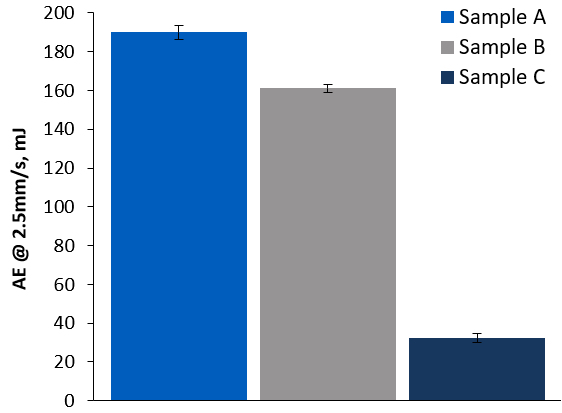
As air is introduced to a powder, the flow of the gas lifts and separates the particles, reducing inter-particular interactions and the overall resistance to flow. The degree to which particles separate is a reliable indicator of the strength of the cohesive bonds. Sample A generated the highest Aerated Energy (AE), which is likely a consequence of its high permeability (see below). Highly permeable powders allow air to traverse the bed readily with little influence on its packing structure. In contrast, Sample C generated the lowest AE, likely as a result of its lower permeability. Furthermore, powders that are sensitive to aeration may also be more prone to segregation and dusting, which can both have a detrimental impact on content uniformity.
Dynamic Testing: Basic Flowability Energy
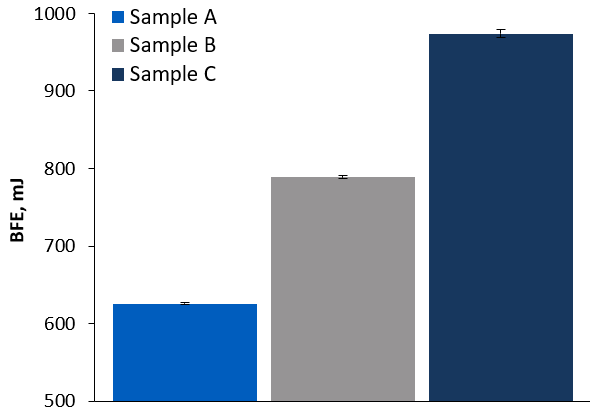
Sample A generated the lowest Basic Flowability Energy (BFE), requiring less energy to move the blade through the powder. Sample C generated the highest. In this case, low BFE is indicative of a powder that is able to flow more freely under the forced flow conditions present in a shoe feeder operation.
Bulk Testing: Permeability
Sample C generated the highest Pressure Drop across the Powder Bed (lowest Permeability), indicating the greatest resistance to the passage of air. Low Permeability means that air entrained in the powder when it enters the sachet cannot escape which can lead to high weight variation across a manufacturing batch. Sample A was less permeable than Sample B, suggesting that an extreme value for any parameter may not result in optimal performance.

























 (All Rights Reserved)