

Many powders have poor basic flow properties: They block in hoppers and die feed frames, exhibit inconsistent or pulsatile discharge rates, adhere to surfaces of equipment or don’t mix readily with other materials. In such cases, it is possible to reduce particle-particle friction and change the powder’s bulk resistance to movement by the addition of a lubricant powder. Magnesium Stearate (MgSt) is used extensively as a lubricant in the manufacture of pharmaceutical oral solid dosage forms. It is commonly added to formulations in low concentrations (typically < 1% w/w) immediately prior to tableting.
Over a range of processes, however, the relationship between flow additive and substrate is less well-understood. Due to the differing demands placed on powders by different processes, the relative influence of a given additive on a given substrate may not be consistent under all circumstances.
Preparation of Samples
Three different Magnesium Stearate (MgSt) formulations (Stear-O-Wet, Monohydrate & Dihydrate – Malinckrodt) were blended separately with five excipients (Avicel PH101 – FMC; Inhalac 230 & Granulac 70 – Meggle; C*Mannidex & C*Sorbidex – Cargill).
The blending was undertaken for a fixed period and rotational speed in a Turbula T2A mixer (Willy A Bachofen AG). The resultant blends were tested using an FT4 Powder Rheometer® to evaluate their Dynamic Flow, Bulk and Shear properties, and compared with the results generated for their respective substrates without lubricant.
The Relative Influence of Flow Additive Content on Flow Properties
Dynamic Testing: Basic Flowability Energy
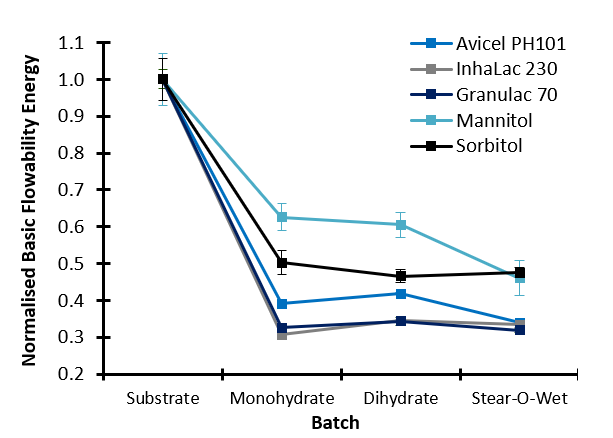
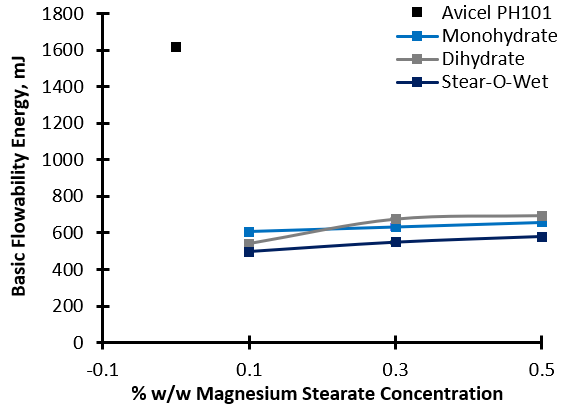
All lubricants significantly reduce the BFE of the substrates, indicating increased flowability in dynamic, forced flow operations such as feeding and blending, with the Inhalac 230 showing the greatest sensitivity to lubrication overall and Mannitol the least. Considering Avicel PH101 as the substrate, even small quantities of lubricant (0.1%) significantly improve the dynamic flow properties, but increases in concentration do not result in further enhancement.
Bulk Testing: Compressibility

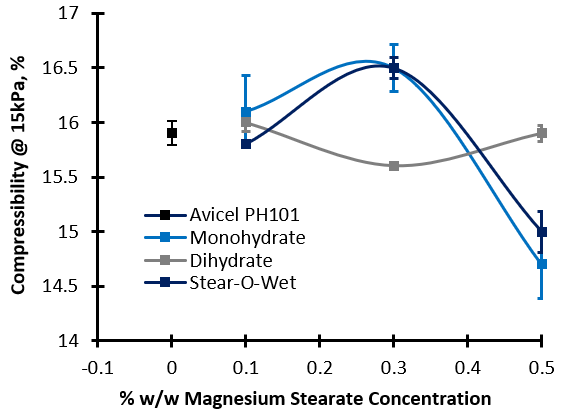
The addition of lubricant to Inhalac 230 caused significant changes in Compressibility. The Mono- and Dihydrates generated a reduction in Compressibility, but the addition of Stear-O-Wet caused an increase, indicating that the different lubricants interact with the substrate in different ways. Only moderate changes in Compressibility were observed for the other combinations of substrate and lubricant. Using Avicel PH101 as an example, the substrate showed a divergent response to the addition of different grades. Monohydrate and Stear-O-wet caused an increase in Compressibility at low concentration followed by a decrease as concentration increased. Dihydrate caused the opposite response. High Compressibility is often a sign of cohesivity within the bulk, and can prove detrimental to compaction operations such as tableting.
Shear Cell Testing

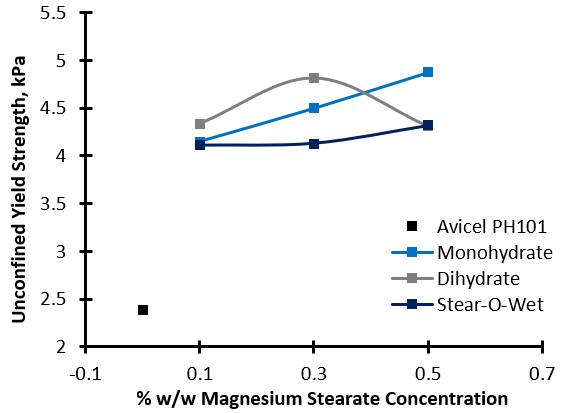
The Dihydrate and Stear-O-Wet typically increase the UYS of the substrates (drastically in the case of the Sorbitol/Dihydrate blend), indicating that these combinations would become more resistant to the onset of flow following storage (hence why lub...




























 (All Rights Reserved)