

Microcrystalline Cellulose (MCC) has been used as a pharmaceutical excipient for many years, due to its abundance, ease of production and resistance to degradation. As with any excipient, however, variability between batches of supplied material can in turn lead to similar variability in processing, resulting in product that is out of specification, and needs to be reworked or even scrapped. Recent Quality by Design (QbD) initiatives have made it necessary to optimise production processes to ensure the consistency and reliability of final products.

A robust method of quantifying the variations in batches of excipients that contribute to differences in downstream process behaviour enables a design space of acceptable raw material properties to be established. This approach is an essential part of QbD. However, even well-established techniques for material characterisation (such as particle size analysis) do not always provide the required differentiation, as they only evaluate of one physical property of the particles.
Multivariate Analysis of Powder Batches
Three grades of MCC were used as an excipient in the production of pharmaceutical tablets by direct compression. Particle size analysis of the three grades generated almost identical D50 values (100 µm) for each grade, and it was determined that three samples were indistinguishable from each other.
All three samples were further analysed using an FT4 Powder Rheometer®, to evaluate whether differences existed that weren’t identified by the D50 value and consequently whether particle size alone is sufficient as a tool predicting in-process performance.
Test Results
Dynamic Testing: Aeration
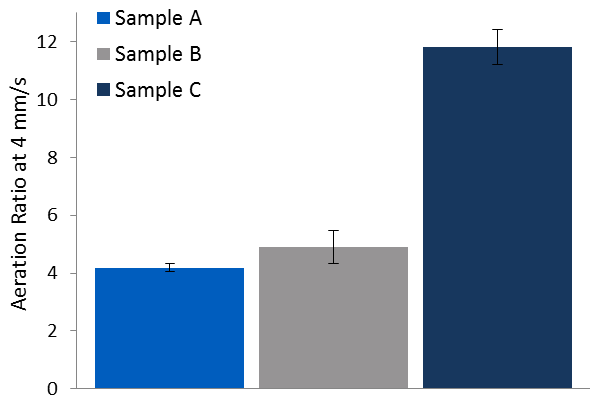
Sample C generated a significantly higher Aeration Ratio (AR) than the other samples, demonstrating that its packing structure changes to a greater extent when air is introduced into the sample. This typically indicates a lower degree of cohesive strength between particles. Sample A and Sample B exhibited different responses, with the lower sensitivity to the introduction of air suggesting greater cohesivity compared to Sample C.
Bulk Testing: Permeability
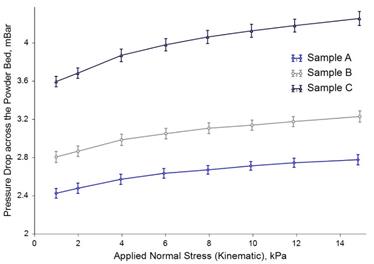
Sample C generated a considerably higher Pressure Drop across the Powder Bed than the other two samples, indicating that it is the least permeable of the three. Low permeability means that any air that becomes entrained in the bulk is less able to escape. Considering the example of a tabletting process, greater air content within the dose would typically lead to capping and lamination as well as weight variation in the final product.
Shear Cell Testing
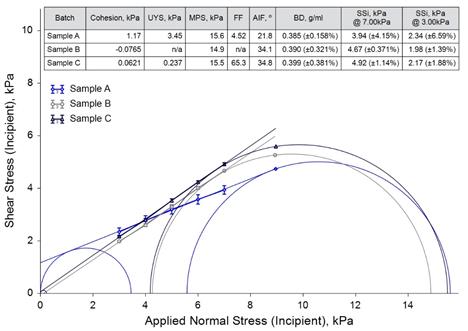
Sample A showed considerably different behaviour to the other two samples, generating the highest Shear Stress values at low normal stress levels, but the lowest values at higher levels. This suggests that the way the powders perform in a given process would be heavily influenced by stress levels they are subjected to, and illustrates the need to characterise powders using process relevant techniques. Considering the results for Sample B, the Yield Locus, generated by a best-fit line through the data points, is so steep that it intercepts the y-axis below the origin. This leads to a negative value for Cohesion, and generates no result for Flow Function (as the minor Mohr circle cannot be constructed in order to produce a value for Unconfined Yield Strength). This illustrates the importance...




























 (All Rights Reserved)