

In the pharmaceutical industry, the blending of a small fraction of active pharmaceutical ingredient (API) with a bulk excipient, and then subsequent processing though various unit operations, is an essential part of many manufacturing processes. The way that the blend behaves in downstream processes will be a function of the properties of the components of that blend.
When manufacturing formulations that will be delivered in capsule form, the blend requires suitable characteristics to ensure a precise and accurate fill of the dosing capsule. The ability to characterise formulations with respect to process behaviour is an essential part of Quality by Design (QbD). A method of quantifying the properties of powdered formulations that are conducive to good performance in a dosator, allows a design space to be defined, specifying material properties that will result in high quality final products. This provides significant commercial benefits in terms of higher productivity and reduced wastage.

Performance Variation Between Similar Formulations
Three powdered formulations were used in the production of a DPI product. Differences in the quality of the final product were observed depending on which formulation was used. Of the three formulations, Formulation 1 represented average behaviour in terms of filling performance from the dosator, whereas Formulation 2 represented the worst behaviour, and Formulation 3 the best.
Samples from the three formulations were evaluated using an FT4 Powder Rheometer®. The tests investigated the Dynamic, Bulk and Shear properties of the samples, in order to identify trends that correlated with the dosator performance.
Test Results
Dynamic Testing: Specific Energy
Formulation 2 had the highest Specific Energy of the three materials, and Formulation 3 the lowest. High Specific Energy represents a greater degree of mechanical interlocking and friction within the bulk, typically leading to problems in operations such as filling, where gravitational flow is critical.
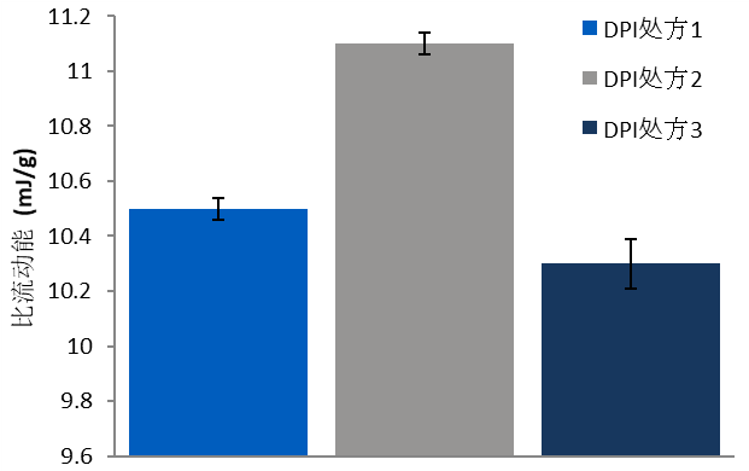
Figure 1
Bulk Testing: Compressibility
Formulation 2 was the most compressible of the samples, and Formulation 3 the least. High Compressibility indicates that a powder entrains a greater proportion of air within its bulk, which is a property typically associated with more cohesive powders.
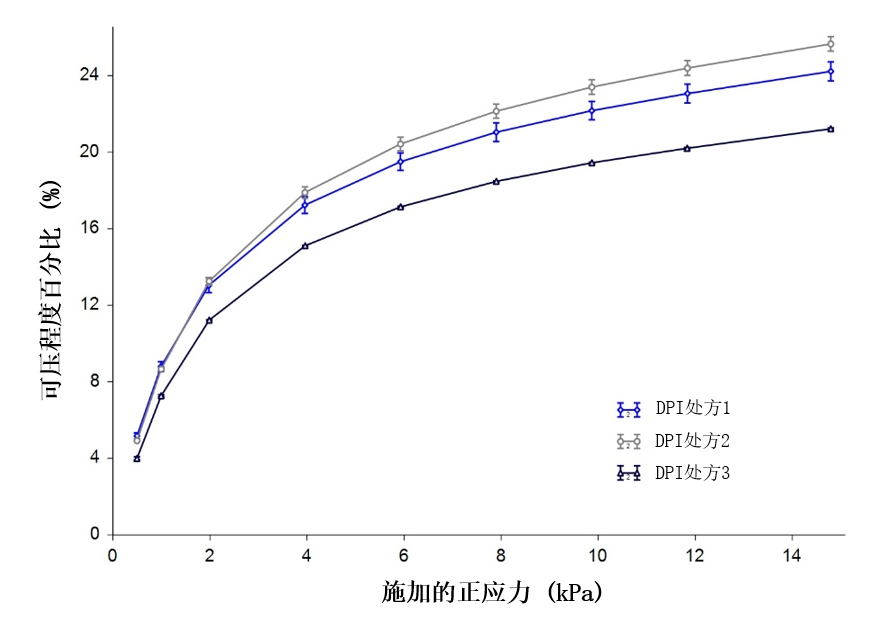
Figure 2
Shear Cell Testing
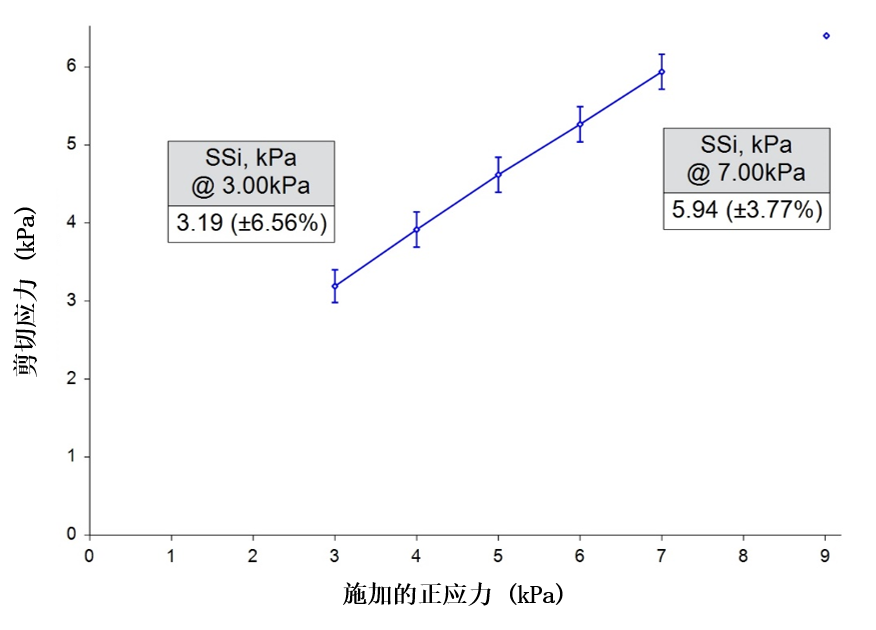
Figure 3
Minimal differentiation was observed between the three samples, with six data sets, i.e. two repeats on each sample, generating near identical Shear Stress values to within an acceptable standard deviation. This lack of correlation with the process behaviour illustrates how Shear Cell testing, designed to investigate how a powder transitions from a static to dynamic state following consolidation, may not be relevant to the more dynamic, low-stress conditions that a powder is exposed to in the dosing process.
Conclusions
The FT4 has identified clear and repeatable differences between three similar formulations which correlated well with the relative performance observed in the dosator. Specific Energy and Compressibility were shown to be highly differentiating suggesting that mechanical interlocking/friction and packing structure of th...

























 (All Rights Reserved)