

Filling is a common operation across all industries, although fill weights and tolerances vary widely. The pharmaceutical industry often requires milligram doses to be filled accurately and at high speed, in order to meet the stringent criteria and high throughput requirements of tablet manufacture. By contrast, the bulk chemicals and minerals industries may load powders into 20 ton containers, employing a much longer filling process and without the regulatory pressures governing accuracy.
The factors that influence filling efficiency will depend on the type of equipment being used. Some systems are purely gravity driven, whilst others rely on force-feeding. In many applications, such as tablet manufacture on a rotary press, the powder fills the dies through a combination of gravity and force-fed flow. The influence of each of the two mechanisms will depend on the geometry of the feedframe, the flow rate through the press and the characteristics of the powder. It is easy to see, with wide variation in each of these variables that this is a complex process and remains challenging to model from knowledge of a limited number of particle properties and process parameters.
At large scale, such as filling of bags or bulk containers, the process might be volumetric filling or one based on mass. In both cases it is typical that augers or rotary valves directly attached to the bottom of the feed hopper are employed. In this configuration, the factors that control filling efficiency may be different to those in tablet manufacture, however, efficiency across all scales and in all processes will depend on the compatibility of the material properties with the conditions imposed in the processing environment.
Die Filling
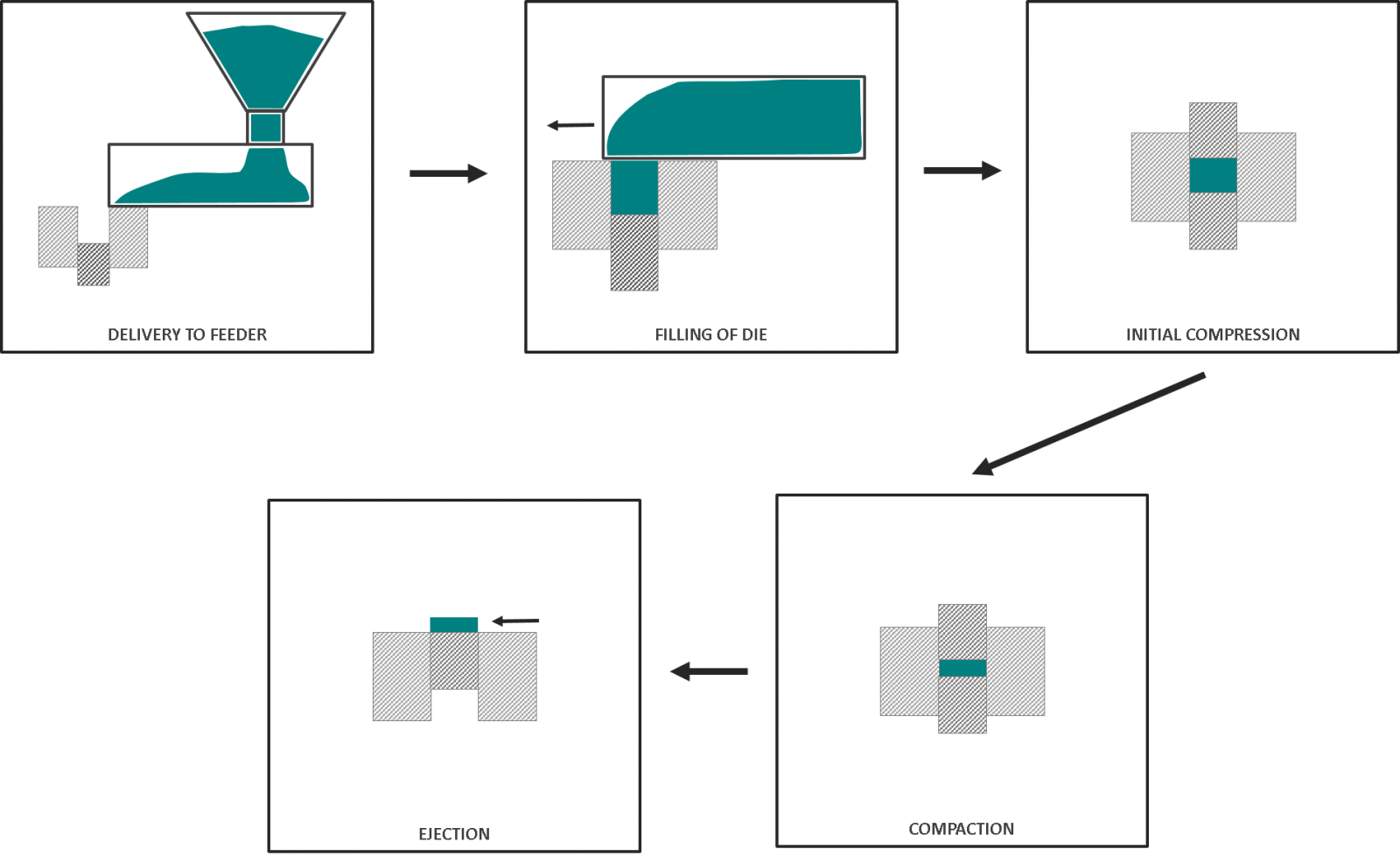
Figure 1
In this example of a typical die filling process, the filling “shoe” moves relative to the stationary die, as opposed to the die moving underneath the feedframe, as in a rotary tablet press. There are many geometries and configurations, but in all cases there is a common objective – to fill the die in a homogeneous manner, in a time frame that enables the target throughput to be achieved.
In the example, powder is discharged from the hopper into the filling shoe. The shoe then moves laterally across the top of the die and powder flows into the empty cavity below. This particular configuration is gravitationally induced and involves relatively low stress, as there are few forces consolidating the powder in the shoe. By contrast, in a tablet press feedframe the stresses will be higher as the feedframe paddles force powder to circulate on top of the table. The consistency of flow of powder into the feedframe will influence the stress in the powder as it circulates, as will the speed of the feedframe relative to the turret speed. As this can be set independently, it is possible to configure the feedframe to generate a range of dynamics and stress conditions, simply by altering its speed relative to the turret. The effect is to adjust the amount of forced flow that contributes to flow into the die, and also from where in the feedframe the powder exits into the die. Changing the shape of the paddles is one method of managing the extent to which forced flow, rather than purely gravimetric flow, contributes to the filling process.
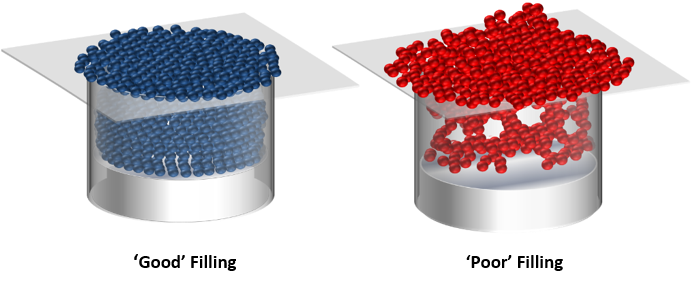
Figure 2
As with all powder processing, it is necessary to consider the compatibility of the powder with the process conditions. A successful outcome, in this case consistently achieving target fill weight, depends on the characteristics of the powder suiting the conditions imposed by the process. Whether gravity, force-fed, or a combination of both, predicting performance can only be achieved by understanding the process conditions and measuring the relevant powder characteristics.
The goal of the process is to uniformly fill the die with powder, witho...
























 (All Rights Reserved)