

Additive manufacturing, also known as 3D printing, is a potentially transformative, highly efficient manufacturing technique. It involves ‘printing’ often intricate components to a tight specification by gradually building up powder layers which are then selectively fused together. Controlling the performance of the powders is critical for process efficiency and end product quality. How the powder flows, and packs as the layers are formed, are defining aspects of this performance. Variability in feedstock can lead to inconsistent bulk density, non-uniform layering, low tensile strength and poor surface finish.
The extent to which AM will shape the industrial landscape depends on the development of high-speed, precision machinery, and on the identification and consistent supply of powders able to meet the exacting demands of these machines. Increasingly the focus is turning to the powders themselves and how they can be optimised in an intelligent and reliable way. Powder characterisation has a vital role to play in supporting this process, and testing techniques that can reliably measure properties that correlate directly with AM performance are essential. Identifying which powder properties lead to uniform, repeatable performance of powder allows new formulations to be optimised, without the significant financial and time implications associated with running samples through the process to assess suitability, and helps reduce the occurrence of final products that are out of specification.
Existing techniques such as Angle of Repose testing, Flow through a Funnel, and Bulk Density measurements are well-documented. However, these methods were developed without the benefits of modern technology, and can sometimes be too insensitive to accurately characterise subtle differences between powders that behave differently in process.
The FT4 Powder Rheometer® is a universal powder tester that provides automated, reliable and comprehensive measurements of bulk material characteristics. This information can be correlated with process experience to improve processing efficiency and aid quality control. Specialising in the measurement of dynamic flow properties, the FT4 also incorporates a Shear cell, and the ability to measure bulk properties like density, compressibility and permeability.
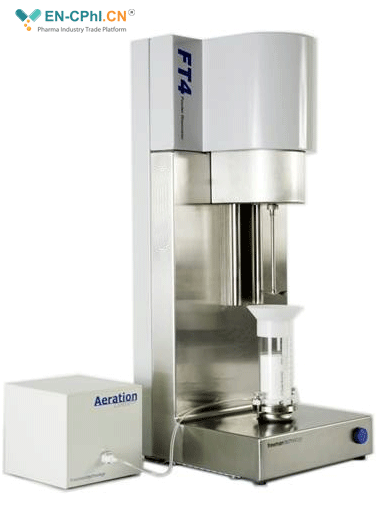
Figure 1
Quantifying Batch-to-Batch Variation in Feedstocks
The tight tolerances within which AM machines operate mean that differences between different batches of feedstocks can lead to significant variability in the properties and quality of the final product. A means of screening each batch before it enters the process can ensure that variation in performance will be avoided. However, traditional powder characterisation techniques are often unable to identify the sometimes very subtle differences in properties that can lead to differences in performance.
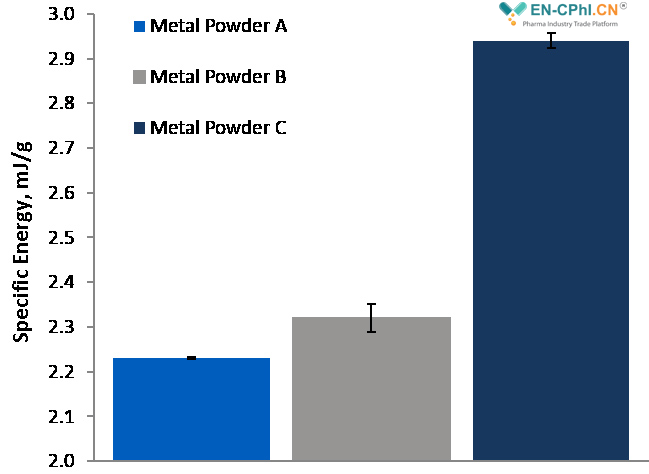
Figure 2
Three examples of stainless steel powder from the same supplier demonstrated significantly variable performance in an AM process; Metal Powder A and Metal Powder B both exhibited acceptable behaviour but Metal Powder C regularly caused blockages and poor deposition, resulting in sub-standard final products. All three samples had virtually identical particle size distributions, and demonstrated a similar response in Angle of Repose and Hall Flow tests.
Evaluating the samples with the FT4, however, illustrated several differences between the samples that correlated well with the process performance. During Dynamic testing, the Specific Energy of the samples clearly differentiated Metal Powder C, with the higher value being indicative of increased mechanical interlocking and particle-particle friction. This increased resistance to flowing over itself is a common cause of blockages and other flow problems in low stress environments.




























 (All Rights Reserved)