Category:
Plant Extracts
CAS NO:
146-48-5
Standard:
ChP,


| CAS: | 146-48-5 |
| MF: | C21H26N2O3 |
| MW: | 354.44 |
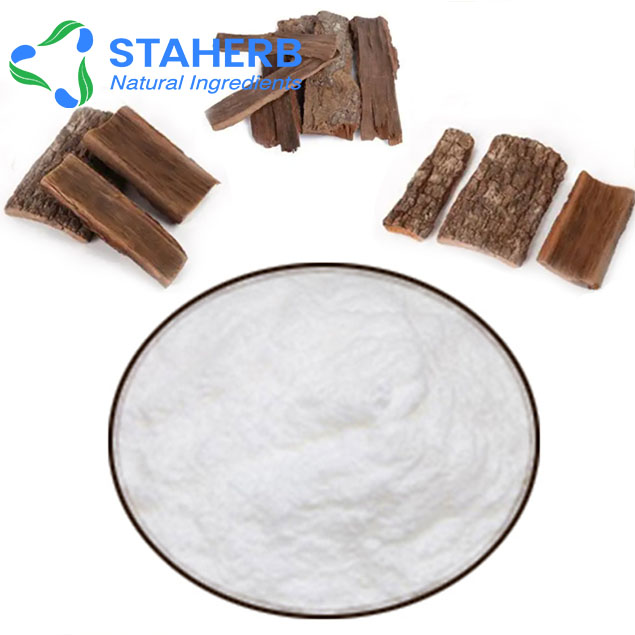
Yohimbine is a natural alkaloid. It was first extracted from the barks of Corynanthe yohimbe, a species of Rubiaceae trees in West Africa. It was reported that, in the dried bark of Pausinystalia johimbe, the content of mixed alkaloids is higher than 6.1%, in which the main component is yohimbine, indicating a great prospect for development . Yohimbe bark has been used as an aphrodisiac in Africa since ancient times. In 1900, it was applied by Kowit and Muller to patients with impotence and paralytic insensitivity caused by neurasthenia and obtained curative effect. From then on, clinical application of yohimbine began. Currently, yohimbine is a pure plant preparation in the treatment of erectile dysfunction with more affirmation and more applications
1. Yohimbine occurs in Corinanthe johimbeK. and Rubiaceae trees. It is also foundin the roots of Rauwolfia serpentina L.and Apocyanaceae. Its derivatives areused therapeutically as adrenergic blockingagents
2. Obtained from leaves and bark of Corynanthe johimbe. Formerly used as an aphrodisiac in veterinary medicine, yohimbine works primarily by acting as an antagonist at α2-adrenergic receptors









 (All Rights Reserved) (All Rights Reserved)