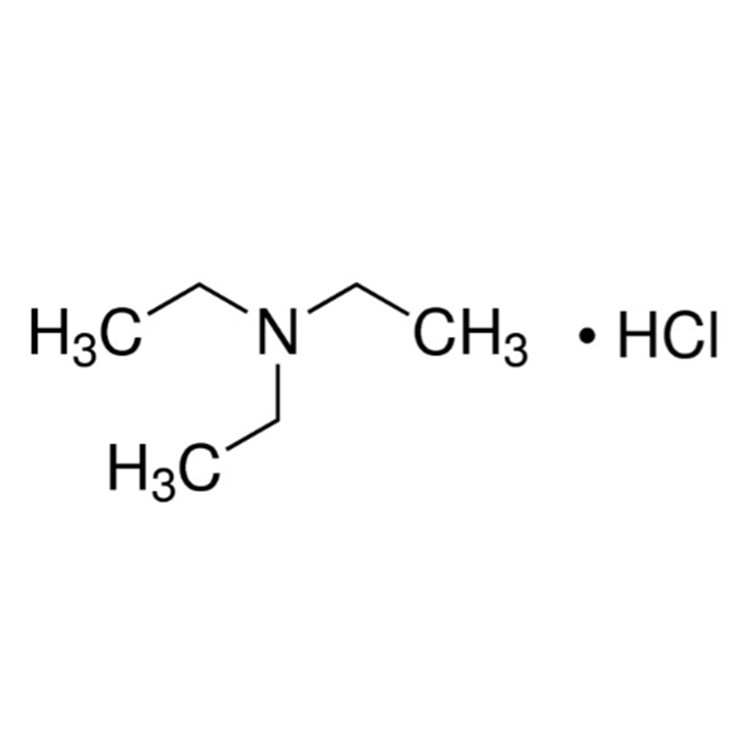
Product Name: Triethylamine Hydrochloride
CAS number: 554-68-7
Molecular formula: C6H16ClN
Molecular weight: 137.65
Purity (content): 98%
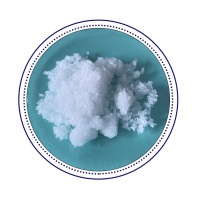
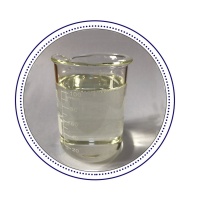
Property: Almost white solid, melting point 258-261 ℃. Easy to deliquescent, soluble in water and alcohol, slightly soluble in benzene, insoluble in ethers.
Usage: Used as a basic raw material for quaternary ammonium salts, pharmaceuticals, pesticides, dyes, and other organic synthesis
Caution: Easy to absorb water, should be sealed and stored dry.
*The following content is generated by AI and is for reference only.
Triethylamine hydrochloride, chemically known as N,N-diethylethanaminium chloride, is a widely utilized organic salt derived from the reaction of triethylamine with hydrochloric acid. Its molecular formula is C6H16ClN, and it is uniquely identified by the CAS number 593-80-2. This compound typically appears as a white to off-white crystalline powder or solid, exhibiting high solubility in water and polar organic solvents, while remaining insoluble in non-polar solvents like benzene or ether. The substance is characterized by its stability under standard conditions, though it may release acidic fumes if exposed to moisture over extended periods.
In the industrial and laboratory sectors, Triethylamine hydrochloride serves several critical functions. Primarily, it acts as a reliable source of the triethylamine base in synthesis reactions where the free amine might be too volatile or difficult to handle directly. By utilizing the hydrochloride salt form, chemists can ensure precise stoichiometric control during the neutralization of acids or the deprotonation of substrates. It is frequently employed as an acid scavenger in peptide coupling reactions, protecting group removals, and various nucleophilic substitution processes within pharmaceutical manufacturing. Additionally, this reagent plays a significant role in the production of agrochemicals, dyes, and polymer additives, facilitating efficient catalytic cycles.
Beyond synthetic chemistry, the compound finds applications in analytical procedures as a reference standard or buffer component. Its distinct physical properties make it suitable for use in electrochemical studies and as a precursor for synthesizing more complex quaternary ammonium salts. Safety protocols dictate that while generally stable, it should be handled with care to avoid inhalation of dust or contact with skin, as it can cause irritation due to its acidic nature upon dissolution. Proper storage in a cool, dry place away from incompatible oxidizers is essential to maintain its integrity. Overall, Triethylamine hydrochloride remains an indispensable reagent in modern chemical research and large-scale industrial applications, offering a versatile solution for managing basicity and acidity in diverse chemical environments.





 (All Rights Reserved)
![8-Oxa-1,3-diazaspiro[4.5]decane-2,4-dione](https://eimg.pharmasources.com/image/product/20250403/60fa7223d5a34f24138486ceea0ffb15jpg)
![8,16-Diazadispiro[6.1.6.2]heptadecan-17-one](https://eimg.pharmasources.com/image/product/20250403/ca91cba8b87e53fc879f8d8764873a40jpg)
![6,8-Dioxo-5,7-diazaspiro[3.4]octane-2-carboxylic acid](https://eimg.pharmasources.com/image/product/20250403/02effeb5a7639bc84ff1f3add3c0c64fjpg)
