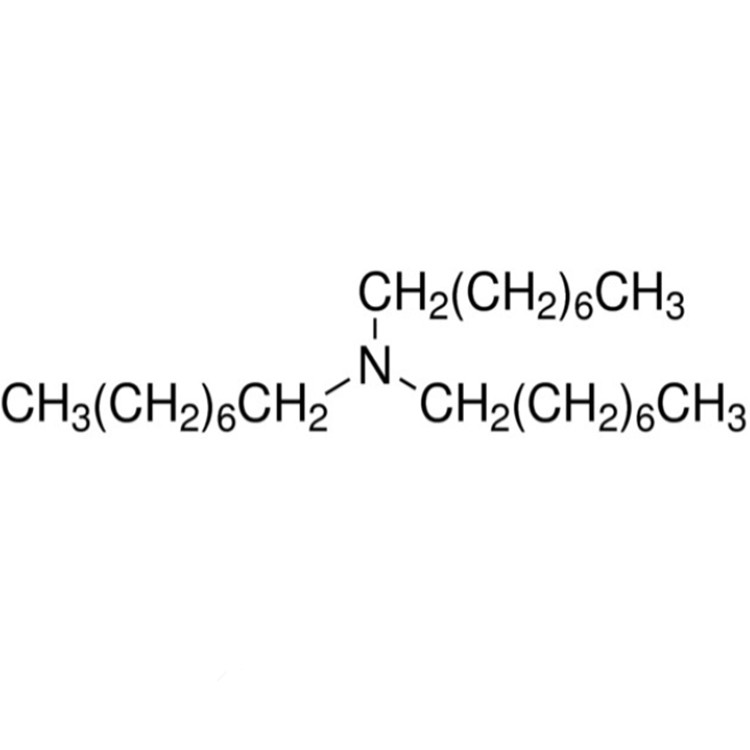
Product Name: Tri-n-octylamine
CAS Number: 1116-76-3
Molecular formula: C24H51N
Purity (content): 98%
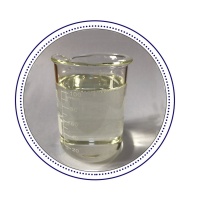
Appearance: Colorless liquid, insoluble in water, easily soluble in organic solvents
Usage: Used as a surfactant and extractant
Attention: Easy to absorb water, should be sealed in a cool and dry place, and stored away from light.
*The following content is generated by AI and is for reference only.
Trioctylamine, often marketed under high-purity specifications such as 98%, is a vital organotertiary amine widely utilized across various industrial sectors. Its chemical identity is defined by the molecular formula C24H51N and the CAS registry number 104-68-7. Structurally, this compound consists of three octyl chains attached to a central nitrogen atom, resulting in a clear, colorless to pale yellow liquid with a faint amine odor. The "hot sale" status of this product typically stems from its exceptional performance as an efficient extractant and stabilizer, making it a preferred choice for manufacturers seeking reliable raw materials at competitive market rates.
The primary application of trioctylamine lies in hydrometallurgy, where it serves as a highly effective solvent for the selective extraction of rare earth elements, uranium, and other metals from aqueous solutions. Its ability to form stable complexes with metal ions allows for precise separation processes essential in the nuclear and electronics industries. Beyond extraction, this amine acts as a robust acid gas scavenger in natural gas processing and petroleum refining, effectively removing hydrogen sulfide and carbon dioxide to ensure fuel quality and pipeline safety. In polymer chemistry, it functions as a thermal stabilizer and catalyst for polyurethane production, enhancing the durability and resistance of plastic materials against degradation.
Furthermore, trioctylamine is employed in the synthesis of quaternary ammonium salts, which are crucial components in surfactants, disinfectants, and phase transfer catalysts. The 98% purity grade ensures minimal impurities that could interfere with sensitive chemical reactions or reduce the efficiency of extraction cycles. Safety data indicates that while it requires standard handling precautions due to potential skin and eye irritation, it remains a versatile and indispensable reagent in modern chemical engineering. As global demand for advanced materials and clean energy solutions grows, the role of high-purity trioctylamine continues to expand, solidifying its position as a cornerstone chemical in both traditional manufacturing and emerging green technologies.





 (All Rights Reserved)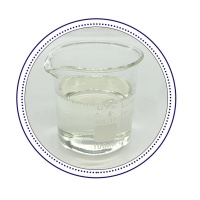
![8,16-Diazadispiro[6.1.6.2]heptadecan-17-one](https://eimg.pharmasources.com/image/product/20250403/ca91cba8b87e53fc879f8d8764873a40jpg)
![8-Oxa-1,3-diazaspiro[4.5]decane-2,4-dione](https://eimg.pharmasources.com/image/product/20250403/60fa7223d5a34f24138486ceea0ffb15jpg)
![6,8-Dioxo-5,7-diazaspiro[3.4]octane-2-carboxylic acid](https://eimg.pharmasources.com/image/product/20250403/02effeb5a7639bc84ff1f3add3c0c64fjpg)