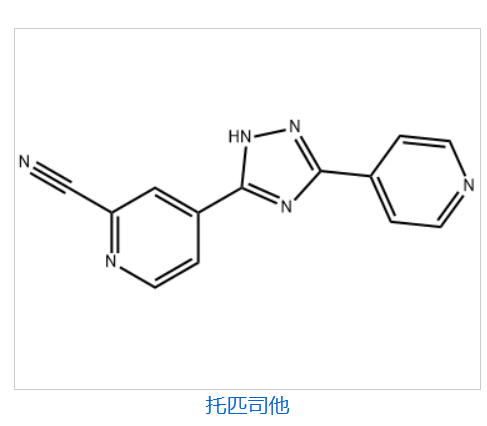
托匹司他化学性质沸点:594.7±60.0°C(Predicted)密度:1.45±0.1g/cm3(Predicted)储存条件:Storeat-20°C溶解度:DMSO:23.5mg/mL(94.67mM;Needultrasonicandwarming)形态:Powder酸度系数(pKa):7.47±0.10(Predicted)颜色:Whitetooff-wChemicalbookhiteInChI:InChI=1S/C13H8N6/c14-8-11-7-10(3-6-16-11)13-17-12(18-19-13)9-1-4-15-5-2-9/p-7H,(H,17,18,19)InChIKey:UBVZQGOVTLIHLH-UHFFFAOYSA-NSMILES:C1(C#N)=NC=CC(C2NN=C(C3C=CN=CC=3)N=2)=C1
*The following content is generated by AI and is for reference only.
Topiroxostat, chemically known as 5-[4-(2-methylpropyl)phenyl]isoxazole-3-carboxylic acid, is a novel and potent non-purine xanthine oxidase inhibitor developed primarily for the management of hyperuricemia associated with gout. Its molecular formula is C16H17NO3, and it is registered under CAS number 905863-25-2. Unlike traditional purine-based inhibitors such as allopurinol, topiroxostat possesses a unique isoxazole scaffold that allows for high selectivity toward xanthine oxidase without cross-reactivity with other enzymes in the purine metabolism pathway. This structural distinction significantly reduces the risk of severe adverse reactions, including life-threatening hypersensitivity syndromes often linked to allopurinol therapy.
The primary clinical utility of topiroxostat lies in its ability to effectively lower serum uric acid levels by blocking the enzymatic conversion of hypoxanthine and xanthine into uric acid. By inhibiting this rate-limiting step, the drug prevents the formation of monosodium urate crystals in joints and soft tissues, thereby reducing the frequency of acute gout flares and facilitating the dissolution of existing tophi. It is approved for use in patients with chronic gout who have not achieved target uric acid levels through conventional therapies or those who cannot tolerate standard treatments due to renal impairment or hypersensitivity. Clinical trials have demonstrated its efficacy in maintaining long-term remission of gout symptoms with a favorable safety profile, even in patients with moderate to severe renal dysfunction where dose adjustments are often unnecessary. Furthermore, its once-daily oral administration enhances patient compliance compared to more frequent dosing regimens. As a next-generation therapeutic agent, topiroxostat represents a significant advancement in rheumatology, offering a robust solution for managing refractory hyperuricemia and improving the quality of life for millions of gout sufferers globally. Its development underscores the ongoing evolution of targeted metabolic therapies designed to minimize toxicity while maximizing therapeutic outcomes.


![8,16-Diazadispiro[6.1.6.2]heptadecan-17-one](https://eimg.pharmasources.com/image/product/20250403/ca91cba8b87e53fc879f8d8764873a40jpg)
![6,8-Dioxo-5,7-diazaspiro[3.4]octane-2-carboxylic acid](https://eimg.pharmasources.com/image/product/20250403/02effeb5a7639bc84ff1f3add3c0c64fjpg)
![8-Oxa-1,3-diazaspiro[4.5]decane-2,4-dione](https://eimg.pharmasources.com/image/product/20250403/60fa7223d5a34f24138486ceea0ffb15jpg)



 (All Rights Reserved)