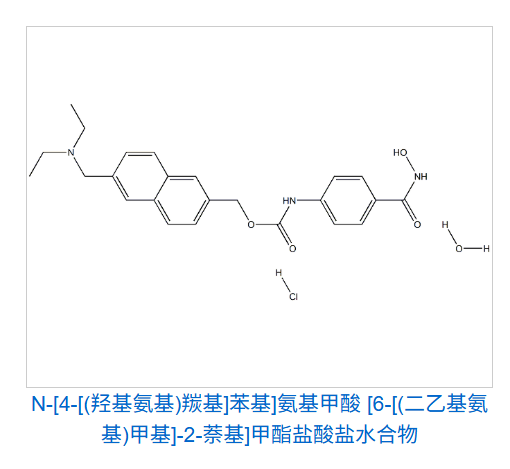
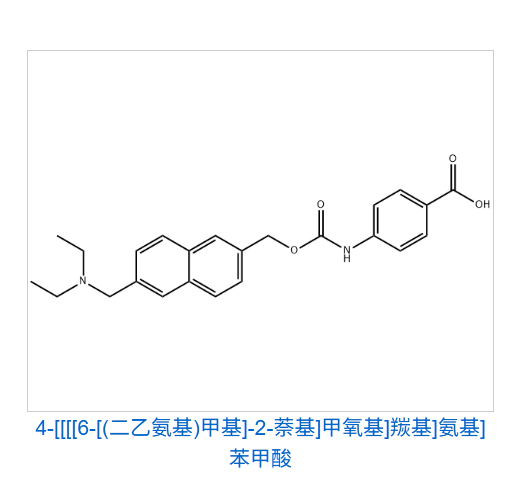
4-[[[[6-[(二乙氨基)甲基]-2-萘基]甲氧基]羰基]氨基]苯甲酸化学性质沸点:557.6±45.0°C(Predicted)密度:1.247±0.06g/cm3(Predicted)酸度系数(pKa):4.31±0.10(Predicted)InChI:InChI=1S/C24H26N2O4/c1-3-26(4-2)15-17-5-7-21-14-18(6-8-20(21)1Chemicalbook3-17)16-30-24(29)25-22-11-9-19(10-12-22)23(27)28/h5-14H,3-4,15-16H2,1-2H3,(H,25,29)(H,27,28)InChIKey:NCHVNKHIEHGHEU-UHFFFAOYSA-NSMILES:C(O)(=O)C1=CC=C(NC(OCC2=CC=C3C(=C2)C=CC(CN(CC)CC)=C3)=O)C=C1
*The following content is generated by AI and is for reference only.
Givinostat Impurity 3 is a critical reference standard associated with the investigational histone deacetylase (HDAC) inhibitor Givinostat, chemically known as diethylaminopropyl-2-(4-chlorophenyl)-1H-indole-3-carboxamide. While Givinostat itself serves as a potent therapeutic candidate for neuromuscular disorders such as Duchenne Muscular Dystrophy and various inflammatory conditions, Impurity 3 represents a specific chemical variant that arises during synthesis or degradation processes. This impurity possesses distinct physicochemical properties compared to the active pharmaceutical ingredient, necessitating rigorous identification and quantification within quality control workflows.
The primary utility of Givinostat Impurity 3 lies in analytical chemistry and pharmaceutical development. It is indispensable for validating high-performance liquid chromatography (HPLC) methods, ensuring the specificity and accuracy of assays used to monitor drug purity. Regulatory agencies, including the FDA and EMA, mandate strict limits on impurities to guarantee patient safety; therefore, having a certified reference standard allows manufacturers to detect trace levels of this specific byproduct. By comparing retention times and spectral data against the impurity standard, laboratories can confirm the absence of excessive contamination in final drug products. Furthermore, this compound aids in stability studies, helping researchers understand how Givinostat degrades under various stress conditions like heat, light, or humidity.
Although not intended for direct clinical administration due to potential unknown toxicity profiles at uncontrolled levels, Givinostat Impurity 3 plays a foundational role in the lifecycle management of the parent drug. Its availability ensures compliance with International Council for Harmonisation (ICH) guidelines regarding impurities. For researchers studying structure-activity relationships or metabolic pathways, this substance provides essential data points. Ultimately, the use of Givinostat Impurity 3 safeguards the integrity of clinical trials and commercial production, ensuring that only safe, effective, and highly pure formulations reach patients suffering from debilitating genetic diseases.


![6,8-Dioxo-5,7-diazaspiro[3.4]octane-2-carboxylic acid](https://eimg.pharmasources.com/image/product/20250403/02effeb5a7639bc84ff1f3add3c0c64fjpg)
![8-Oxa-1,3-diazaspiro[4.5]decane-2,4-dione](https://eimg.pharmasources.com/image/product/20250403/60fa7223d5a34f24138486ceea0ffb15jpg)
![8,16-Diazadispiro[6.1.6.2]heptadecan-17-one](https://eimg.pharmasources.com/image/product/20250403/ca91cba8b87e53fc879f8d8764873a40jpg)



 (All Rights Reserved)