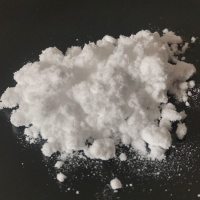
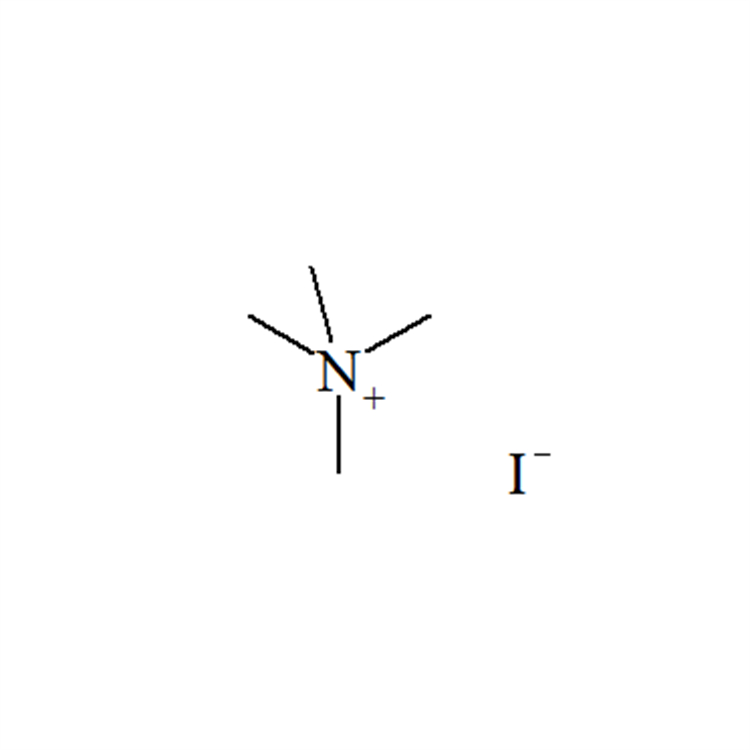
Product Name: Tetramethyl ammonium iodide
CAS number: 75-58-1
Molecular formula: C4H12NI
Molecular weight: 201.0492
Purity (content): 99%
Property: Almost white solid, slightly soluble in water.
Purpose: Polarographic analysis, determination of germanium. Used as a phase transfer catalyst.
Caution: Easy to absorb water, should be sealed and stored dry.
*The following content is generated by AI and is for reference only.
Tetramethylammonium iodide (TMAI) is a quaternary ammonium salt widely utilized in organic synthesis and analytical chemistry. Its molecular formula is C4H12NI, corresponding to a molecular weight of approximately 213.05 g/mol. The compound is characterized by its CAS registry number, 75-59-2. Structurally, TMAI consists of a central nitrogen atom covalently bonded to four methyl groups, carrying a positive charge that is balanced by an iodide anion. This ionic structure grants the substance high solubility in polar solvents such as water and methanol, while remaining insoluble in non-polar organic solvents.
In the pharmaceutical and chemical industries, tetramethylammonium iodide serves primarily as a phase-transfer catalyst or a source of nucleophilic iodide ions. It facilitates reactions where reagents must be transferred between immiscible phases, significantly enhancing reaction rates and yields. Specifically, it is employed in alkylation reactions, the synthesis of heterocyclic compounds, and the preparation of complex natural products. Due to the strong nucleophilicity of the iodide ion, TMAI is also valuable for converting alkyl halides into more reactive intermediates or for introducing iodine atoms into organic frameworks.
Beyond synthetic applications, this compound finds use in electrochemistry and materials science. It acts as an electrolyte additive in certain battery systems and is explored for its potential in fabricating perovskite solar cells, where it helps modulate crystal growth and improve device stability. Additionally, TMAI is used in biochemical research to study membrane transport mechanisms due to the similarity of the tetramethylammonium cation to potassium ions, though with distinct kinetic properties. Handling requires standard precautions, as it can be hygroscopic and may release irritating vapors if exposed to moisture or heat. Proper storage in a cool, dry place under inert atmosphere is recommended to maintain purity and prevent degradation. Overall, tetramethylammonium iodide remains a versatile and essential reagent in modern laboratory settings, bridging fundamental research with industrial-scale manufacturing processes.