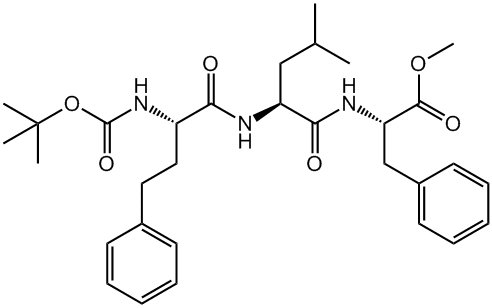
Huateng Pharmaceutical, a global supplier of Pharmaceutical intermediates, offers Carfilzomib intermediate Boc-HPh-Leu-Phe-Ome (CAS No.: 868539-96-2) for your requirements of R&D, evaluation, pilots and commercial along with supportive technical package required for evaluation.
Application: An intermediate of Carfilzomib (C183460) which is a second-generation proteasome inhibitor that is used as a treatment in relapsed and refractory multiple myeloma.
*The following content is generated by AI and is for reference only.
The compound (S)-methyl 2-((S)-2-tert-butoxycarbonylamino-4-phenylbutanamido-4-methylpentanamido)-3-phenylpropanoate is a sophisticated synthetic intermediate primarily utilized in the field of peptide chemistry and medicinal research. While specific commercial catalog data for this exact stereochemical configuration may vary by supplier, its structural composition reveals a complex molecule designed for precise biochemical applications. The molecule features multiple chiral centers, indicated by the "(S)" notation at key positions, which are critical for ensuring high biological specificity when interacting with enzymatic targets or receptors. Structurally, it incorporates a methyl ester group on one terminus, a tert-butoxycarbonyl (Boc) protecting group on the amino functionality to prevent unwanted side reactions during synthesis, and two distinct amide linkages connecting phenylalanine and leucine-derived residues. This specific arrangement suggests its role as a protected dipeptide or tripeptide fragment used in solid-phase peptide synthesis (SPPS). Researchers employ such compounds to construct larger, biologically active peptides that mimic natural protein sequences, often targeting pathways involved in inflammation, pain management, or metabolic regulation. The presence of aromatic phenyl groups enhances lipophilicity, potentially influencing membrane permeability in drug delivery systems. Although a definitive CAS number is not universally standardized for every stereoisomeric variant without specific supplier registration, the chemical identity aligns with custom synthesis orders for pharmaceutical development labs. Its primary utility lies in serving as a building block for creating novel therapeutics, allowing chemists to explore structure-activity relationships (SAR) by modifying adjacent functional groups while maintaining the core scaffold. Furthermore, the Boc group offers stability under acidic conditions but allows for selective deprotection using trifluoroacetic acid, facilitating stepwise assembly of complex molecular architectures. In summary, this specialized reagent represents a vital tool in modern organic synthesis, bridging the gap between simple amino acids and potent bioactive agents, thereby accelerating the discovery of next-generation pharmaceutical candidates through rigorous stereochemical control and modular construction strategies.





 (All Rights Reserved)

![8-Oxa-1,3-diazaspiro[4.5]decane-2,4-dione](https://eimg.pharmasources.com/image/product/20250403/60fa7223d5a34f24138486ceea0ffb15jpg)
![8,16-Diazadispiro[6.1.6.2]heptadecan-17-one](https://eimg.pharmasources.com/image/product/20250403/ca91cba8b87e53fc879f8d8764873a40jpg)
![6,8-Dioxo-5,7-diazaspiro[3.4]octane-2-carboxylic acid](https://eimg.pharmasources.com/image/product/20250403/02effeb5a7639bc84ff1f3add3c0c64fjpg)
