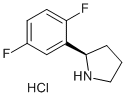
Huateng Pharmaceutical, a global supplier of pharmaceutical intermediates, offers Larotrectinib intermediates (R)-2-(2,5-Difluorophenyl)pyrrolidine hydrochloride (CAS No.: 1218935-60-4) for your requirements of R&D, evaluation, pilots and commercial along with supportive technical package required for evaluation.
*The following content is generated by AI and is for reference only.
(R)-2-(2,5-Difluorophenyl)pyrrolidine hydrochloride is a specialized chiral building block widely utilized in the pharmaceutical and agrochemical industries for the synthesis of complex bioactive molecules. Its chemical structure consists of a pyrrolidine ring substituted with two fluorine atoms at the 2 and 5 positions on the phenyl group, existing as the hydrochloride salt to enhance stability and solubility. The molecular formula is C10H10ClF2N, and it carries the CAS number 148679-34-3. This compound is particularly valued in medicinal chemistry due to the presence of the chiral center, which allows for the precise construction of enantiomerically pure compounds essential for drug efficacy and safety.
The primary application of this reagent lies in its role as a key intermediate in the development of novel therapeutics. Fluorine substitution is a common strategy in drug design to improve metabolic stability, lipophilicity, and binding affinity to biological targets. Consequently, (R)-2-(2,5-Difluorophenyl)pyrrolidine hydrochloride serves as a critical precursor for synthesizing various heterocyclic scaffolds found in anti-inflammatory agents, antihypertensives, and central nervous system modulators. Researchers utilize this chiral amine in coupling reactions, such as nucleophilic substitutions or reductive aminations, to introduce specific stereochemistry into target molecules. The hydrochloride form ensures that the amine remains protonated, facilitating handling and purification processes during multi-step synthetic routes.
In addition to pharmaceutical research, this compound finds utility in academic studies focused on stereoselective catalysis and mechanistic investigations. Its availability in high optical purity makes it an ideal standard for validating new asymmetric synthesis methodologies. While not a commercial drug itself, its structural features contribute significantly to the optimization of lead compounds in early-stage discovery programs. Proper storage under inert atmospheres is recommended to prevent degradation, ensuring consistent performance in sensitive synthetic applications. As the demand for chiral drugs grows, the importance of reliable sources for such specialized intermediates continues to rise, supporting innovation in global healthcare solutions.





 (All Rights Reserved)

![8-Oxa-1,3-diazaspiro[4.5]decane-2,4-dione](https://eimg.pharmasources.com/image/product/20250403/60fa7223d5a34f24138486ceea0ffb15jpg)
![8,16-Diazadispiro[6.1.6.2]heptadecan-17-one](https://eimg.pharmasources.com/image/product/20250403/ca91cba8b87e53fc879f8d8764873a40jpg)
![6,8-Dioxo-5,7-diazaspiro[3.4]octane-2-carboxylic acid](https://eimg.pharmasources.com/image/product/20250403/02effeb5a7639bc84ff1f3add3c0c64fjpg)