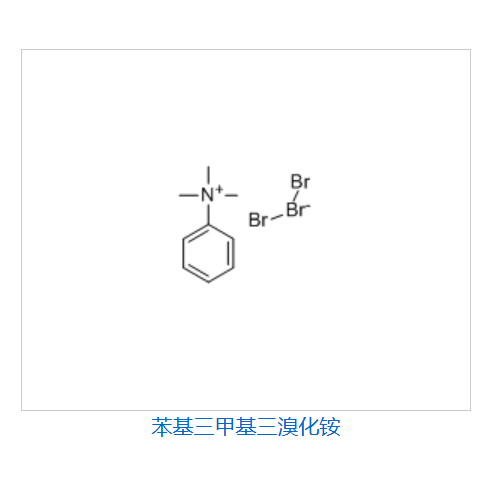
熔点:110-115°C(dec.)(lit.)密度:2.2071(roughestimate)折射率:1.6500(estimate)储存条件:Inertatmosphere,2-8°C溶解度:ethanol:10mg/mLhot,clear形态:CrystallinePowder颜色:OChemicalbookrange水溶解性:Insoluble敏感性:HygroscopicBRN:3919459CAS数据库:4207-56-1(CASDataBaseReference)EPA化学物质信息:Benzenaminium,N,N,N-trimethyl-,(tribromide)(4207-56-1)
*The following content is generated by AI and is for reference only.
Phenyltrimethylammonium tribromide is a specialized quaternary ammonium salt widely recognized in organic synthesis as a convenient and stable source of electrophilic bromine. With the molecular formula C9H13Br3N and the CAS registry number 1560-78-7, this compound serves as a superior alternative to hazardous elemental bromine or liquid bromine solutions. Its solid-state nature offers significant practical advantages, including ease of handling, precise stoichiometric control, and reduced risk of accidental spills or exposure compared to traditional liquid reagents.
The primary application of phenyltrimethylammonium tribromide lies in the bromination of electron-rich aromatic systems, alkenes, and carbonyl compounds. It is particularly effective for the selective monobromination of activated benzene derivatives without requiring strong Lewis acid catalysts often needed with molecular bromine. In alkene chemistry, it facilitates anti-addition reactions to yield vicinal dibromides under mild conditions. Furthermore, this reagent is frequently employed in the oxidative bromination of ketones to form alpha-bromo ketones, a crucial intermediate step in the synthesis of various pharmaceutical agents and agrochemicals.
From a safety perspective, the compound minimizes the generation of corrosive hydrogen bromide gas during reaction workups, thereby simplifying purification processes and reducing environmental impact. The phenyltrimethylammonium cation acts as a non-nucleophilic counterion that stabilizes the tribromide anion, allowing for controlled release of bromine species. This stability makes it ideal for large-scale industrial applications where process safety and reproducibility are paramount. Researchers utilize this reagent in diverse synthetic pathways ranging from natural product total synthesis to the production of advanced materials. Its compatibility with various solvents, including acetonitrile, dichloromethane, and ethyl acetate, further enhances its versatility. Overall, phenyltrimethylammonium tribromide represents a robust, efficient, and safer tool for modern bromination strategies, bridging the gap between laboratory precision and industrial scalability while maintaining high selectivity and yield across a broad spectrum of organic transformations.










 (All Rights Reserved)