Product Description
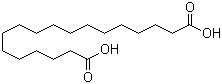
Huateng Pharma, a professional pharmaceutical API and intermediate supplier, provides Semaglutide intermediate Octadecanedioic acid (CAS No. 871-70-5) with high quality and purity, which is a medication for the treatment of type 2 diabetes.
AI Product Description
*The following content is generated by AI and is for reference only.
Octadecanedioic acid, also known as 1,18-octadecanedioic acid or sebacic acid dimer, is a long-chain dicarboxylic acid with the molecular formula C₁₈H₃₄O₄. Its Chemical Abstracts Service (CAS) registry number is 505-67-3. This white to off-white crystalline powder or flake solid features a high melting point, typically ranging between 94°C and 96°C, and exhibits low solubility in water while dissolving readily in organic solvents such as ethanol, ether, and hot benzene. The molecule consists of an eighteen-carbon straight chain terminated by two carboxyl groups at opposite ends, providing significant structural stability and chemical reactivity suitable for various industrial applications.
The primary utility of octadecanedioic acid lies in its role as a specialized monomer in polymer chemistry. It serves as a crucial precursor for synthesizing high-performance polyesters and polyamides, particularly those designed for engineering plastics requiring enhanced thermal resistance and mechanical strength. In the production of biodegradable polymers, this compound contributes to the formation of aliphatic polyester chains that degrade more efficiently than traditional petrochemical alternatives, aligning with global sustainability goals. Furthermore, it acts as a valuable intermediate in the manufacture of lubricants, plasticizers, and surface coatings. Its long hydrocarbon backbone imparts excellent flexibility and moisture resistance to finished products, making it ideal for use in automotive components, electrical insulation materials, and specialized adhesives.
In the pharmaceutical and cosmetic sectors, derivatives of octadecanedioic acid are occasionally utilized as excipients or emulsifying agents due to their mild chemical nature and compatibility with biological systems. Additionally, research continues into its potential applications in drug delivery systems, where its amphiphilic properties can facilitate controlled release mechanisms. As industries increasingly demand eco-friendly and high-efficiency materials, the versatility of octadecanedioic acid ensures its continued relevance in advanced material science. Manufacturers prioritize its purity levels to meet strict regulatory standards for food contact materials and medical devices. Overall, this versatile dicarboxylic acid remains a cornerstone component in the synthesis of next-generation functional materials, bridging the gap between traditional petrochemical processes and sustainable green chemistry initiatives.





 (All Rights Reserved)

![6,8-Dioxo-5,7-diazaspiro[3.4]octane-2-carboxylic acid](https://eimg.pharmasources.com/image/product/20250403/02effeb5a7639bc84ff1f3add3c0c64fjpg)
![8,16-Diazadispiro[6.1.6.2]heptadecan-17-one](https://eimg.pharmasources.com/image/product/20250403/ca91cba8b87e53fc879f8d8764873a40jpg)
![8-Oxa-1,3-diazaspiro[4.5]decane-2,4-dione](https://eimg.pharmasources.com/image/product/20250403/60fa7223d5a34f24138486ceea0ffb15jpg)
