Product Description
- CAS No.:
784105-33-5
- Synonyms:
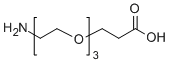
Amine-PEG3-COOH
- Purity:
≥95%
- Molecular formula:
C9H19NO5
- Molecular weight:
221.25
- Uses:
Applicated in medical research, drug-release, nanotechnology and new materials research, cell culture. In the study of ligand, polypeptide synthesis support, a graft polymer compounds, new materials, and polyethylene glycol-modified functional coatings and other aspects of the active compound.
AI Product Description
*The following content is generated by AI and is for reference only.
NH2-PEG3-COOH is a widely utilized heterobifunctional polyethylene glycol (PEG) linker designed for bioconjugation applications in pharmaceutical research and biotechnology. Its molecular formula is C10H21NO5, reflecting the specific arrangement of three ethylene glycol units connecting an amino group at one terminus and a carboxylic acid group at the other. While a single universal CAS number does not exist due to potential variations in purity or supplier-specific synthesis methods, this compound is generally cataloged under specific identifiers provided by major chemical vendors. The molecule features a hydrophilic PEG spacer arm consisting of three repeating ethylene oxide units, which provides optimal flexibility and solubility in aqueous environments while minimizing steric hindrance during conjugation reactions.
The primary utility of NH2-PEG3-COOH lies in its ability to bridge amine-containing biomolecules, such as proteins, peptides, or antibodies, with carboxyl-functionalized entities like drugs, fluorophores, or solid supports. The amino group readily reacts with activated carboxyl groups using standard coupling reagents like EDC/NHS, while the terminal carboxyl group can be targeted by amines to form stable amide bonds. This dual functionality makes it an essential building block for synthesizing antibody-drug conjugates (ADCs), where precise control over drug-to-antibody ratios is critical for therapeutic efficacy. Furthermore, the short PEG chain length enhances the stability of the resulting conjugate against enzymatic degradation while maintaining favorable pharmacokinetic properties, such as reduced immunogenicity and prolonged circulation half-life in vivo.
In diagnostic imaging, this linker facilitates the attachment of radiolabels or fluorescent tags to targeting ligands without compromising biological activity. Its water solubility ensures compatibility with physiological buffers, simplifying purification processes. Researchers frequently employ NH2-PEG3-COOH in developing peptide libraries, biosensors, and surface modification protocols for medical devices. By incorporating this versatile spacer, scientists can effectively modulate the spatial orientation and distance between functional moieties, optimizing interaction kinetics. Consequently, NH2-PEG3-COOH remains a cornerstone reagent in modern medicinal chemistry, enabling the creation of sophisticated macromolecular architectures for both academic investigation and clinical translation.



 (All Rights Reserved)