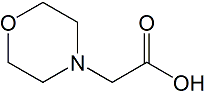
Huateng Pharmaceutical, a global supplier of API intermediates, offers Carfilzomib intermediate Morpholin-4-ylacetic acid (CAS No.: 3235-69-6) for your requirements of R&D, evaluation, pilots and commercial along with supportive technical package required for evaluation.
Application: An intermediate of Carfilzomib (C183460) which is a second-generation proteasome inhibitor that is used as a treatment in relapsed and refractory multiple myeloma.
*The following content is generated by AI and is for reference only.
Morpholin-4-ylacetic acid, also known as morpholine acetic acid or 2-(morpholin-4-yl)acetic acid, is a versatile organic compound widely utilized in pharmaceutical and chemical synthesis industries. Its molecular formula is C₅H₁₁NO₃, and it carries the CAS registry number 38607-91-5. Structurally, this molecule features a morpholine ring attached to an acetic acid moiety, providing a unique combination of basic nitrogen and acidic carboxylic group functionalities. This dual nature makes it an excellent intermediate for creating complex heterocyclic systems and bioactive molecules.
In the pharmaceutical sector, morpholin-4-ylacetic acid serves as a crucial building block for synthesizing various therapeutic agents, including anti-inflammatory drugs, antihistamines, and central nervous system modulators. The presence of the morpholine ring often enhances the solubility and metabolic stability of drug candidates, while the acetic acid side chain offers a convenient site for further functionalization through amide bond formation or esterification. Consequently, medicinal chemists frequently employ this reagent to optimize lead compounds during drug discovery processes.
Beyond medicine, this compound finds applications in agrochemical development, where it contributes to the creation of novel herbicides and fungicides with improved efficacy and environmental profiles. In materials science, it acts as a ligand or chelating agent in coordination chemistry, facilitating the synthesis of metal-organic frameworks and specialized catalysts. The compound is typically available as a white to off-white crystalline powder, stable under standard storage conditions but requiring protection from moisture to prevent degradation.
Manufacturers produce morpholin-4-ylacetic acid via the reaction of morpholine with chloroacetic acid under controlled alkaline conditions, ensuring high purity grades suitable for research and industrial scale-up. Safety data indicates that while generally safe to handle with standard laboratory precautions, direct contact should be avoided due to potential skin and eye irritation. As demand for advanced organic intermediates grows, morpholin-4-ylacetic acid remains a staple reagent in global chemical supply chains, bridging fundamental organic synthesis with practical applications in health and agriculture. Its structural versatility continues to drive innovation across multiple scientific disciplines.





 (All Rights Reserved)

![8-Oxa-1,3-diazaspiro[4.5]decane-2,4-dione](https://eimg.pharmasources.com/image/product/20250403/60fa7223d5a34f24138486ceea0ffb15jpg)
![8,16-Diazadispiro[6.1.6.2]heptadecan-17-one](https://eimg.pharmasources.com/image/product/20250403/ca91cba8b87e53fc879f8d8764873a40jpg)
![6,8-Dioxo-5,7-diazaspiro[3.4]octane-2-carboxylic acid](https://eimg.pharmasources.com/image/product/20250403/02effeb5a7639bc84ff1f3add3c0c64fjpg)
