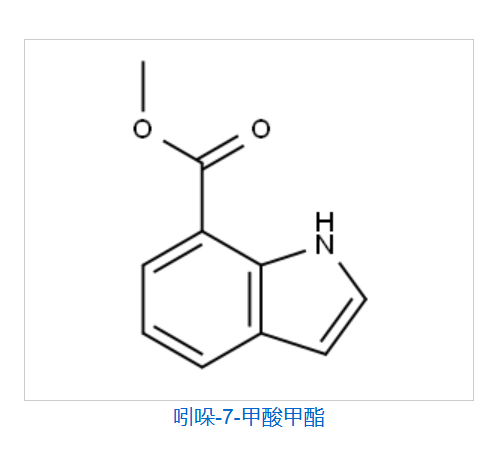
吲哚-7-甲酸甲酯化学性质熔点:47-48°C沸点:331.7±15.0°C(Predicted)密度:1.253±0.06g/cm3(Predicted)储存条件:Inertatmosphere,RoomTemperature溶解度:Chloroform(Slightly),Methanol(Slightly)酸度系数(pKa):15.42±0.30(Predicted)形态:Solid颜Chemicalbook色:WhitetoOff-WhiteInChI:InChI=1S/C10H9NO2/c1-13-10(12)8-4-2-3-7-5-6-11-9(7)8/h2-6,11H,1H3InChIKey:FTLOEULOTNVCGF-UHFFFAOYSA-NSMILES:N1C2=C(C=CC=C2C(OC)=O)C=C1CAS数据库:93247-78-0(CASDataBaseReference)
*The following content is generated by AI and is for reference only.
Methyl 1H-indole-7-carboxylate is a versatile organic compound belonging to the indole family, characterized by a fused benzene and pyrrole ring system substituted with a methyl ester group at the seventh position. Its molecular formula is C₁₀H₉NO₂, and it carries the CAS registry number 32960-54-8. This chemical serves as a critical intermediate in pharmaceutical synthesis and materials science due to its unique structural properties. The indole nucleus is a fundamental scaffold found in numerous bioactive natural products, including alkaloids and neurotransmitters like serotonin, making this derivative highly valuable for medicinal chemistry research.
In the pharmaceutical industry, Methyl 1H-indole-7-carboxylate is frequently employed as a building block for constructing complex heterocyclic molecules. It facilitates the development of novel drugs targeting central nervous system disorders, anti-inflammatory agents, and anticancer therapeutics. Researchers utilize its reactive ester functionality to perform various transformations, such as aminolysis, reduction, or condensation reactions, enabling the introduction of diverse functional groups essential for optimizing drug potency and selectivity. Furthermore, the compound plays a significant role in agrochemical applications, where indole derivatives are often explored for their potential as plant growth regulators or pesticides.
From a synthetic chemistry perspective, the molecule offers excellent stability under standard laboratory conditions while maintaining sufficient reactivity for further derivatization. Its solubility profile allows for easy handling in common organic solvents, streamlining multi-step synthesis protocols. As a precursor, it contributes to the creation of advanced materials and dyes, expanding its utility beyond traditional medicine. Despite its specialized nature, availability through chemical suppliers ensures accessibility for academic and industrial laboratories worldwide. Continuous research into indole-based compounds underscores the importance of derivatives like Methyl 1H-indole-7-carboxylate in advancing scientific innovation. By providing a reliable route to functionalized indoles, this compound supports the ongoing quest for new therapeutic agents and functional materials, reinforcing its status as an indispensable tool in modern chemical research and development.




![6,8-Dioxo-5,7-diazaspiro[3.4]octane-2-carboxylic acid](https://eimg.pharmasources.com/image/product/20250403/02effeb5a7639bc84ff1f3add3c0c64fjpg)

![8-Oxa-1,3-diazaspiro[4.5]decane-2,4-dione](https://eimg.pharmasources.com/image/product/20250403/60fa7223d5a34f24138486ceea0ffb15jpg)


![8,16-Diazadispiro[6.1.6.2]heptadecan-17-one](https://eimg.pharmasources.com/image/product/20250403/ca91cba8b87e53fc879f8d8764873a40jpg)



 (All Rights Reserved)