Product Description
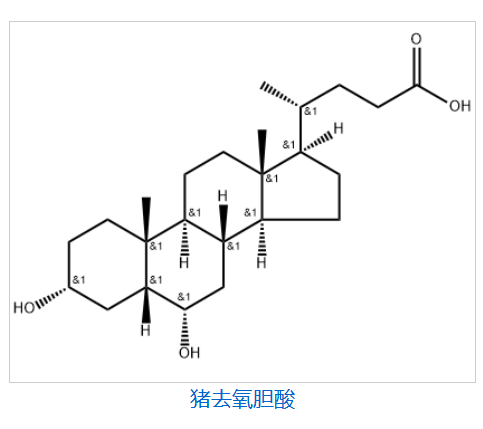
猪去氧胆酸化学性质熔点:200-201°C(lit.)比旋光度:D20+8°(alc)沸点:437.26°C(roughestimate)密度:0.9985(roughestimate)折射率:1.4460(estimate)储存条件:Refrigerator溶解度:SolubilityinmethanChemicalbookol,veryfaintturbidity.Slightlysolubleinalcohol,acetone,etherandveryslightlysolubleinchloroform.酸度系数(pKa):4.76±0.10(Predicted)形态:Solid颜色:WhitetoOff-White
AI Product Description
*The following content is generated by AI and is for reference only.
Hyodeoxycholic acid (HDCA), chemically known as 3α,6α-dihydroxy-5β-cholan-24-oic acid, is a naturally occurring secondary bile acid derived from the metabolism of cholic acid by intestinal bacteria. With the molecular formula C24H40O4 and a CAS number of 87-49-4, this compound plays a significant role in lipid digestion and absorption within the mammalian gastrointestinal tract. Structurally, it features a steroid backbone with hydroxyl groups at the 3 and 6 positions, which contributes to its unique amphipathic properties, allowing it to solubilize dietary fats and cholesterol effectively.
In pharmaceutical and research contexts, HDCA is primarily utilized as a critical reagent for studying bile acid physiology, metabolic disorders, and liver function. It serves as an essential standard in analytical chemistry for identifying bile acid profiles in biological samples such as serum, urine, and feces through techniques like liquid chromatography-mass spectrometry. Furthermore, due to its specific interaction with nuclear receptors like farnesoid X receptor (FXR), researchers investigate its potential therapeutic applications in treating metabolic syndromes, including non-alcoholic fatty liver disease (NAFLD) and hypercholesterolemia. Unlike some other bile acids, HDCA exhibits distinct pharmacokinetic behaviors, making it valuable for comparative studies on bile acid toxicity and enterohepatic circulation.
Commercially available as a high-purity powder, Hyodeoxycholic acid is widely distributed among chemical suppliers for academic laboratories and biotechnology firms. Its stability under standard storage conditions ensures reliability in long-term experimental protocols. While not currently a first-line clinical drug, ongoing investigations into its regulatory effects on glucose and lipid metabolism suggest promising avenues for future drug development. Researchers must handle the substance with appropriate safety precautions, adhering to standard laboratory protocols for organic acids. As a fundamental component of human bile, understanding HDCA provides deeper insights into digestive health and systemic metabolic regulation, bridging the gap between basic biochemistry and clinical medicine.


![6,8-Dioxo-5,7-diazaspiro[3.4]octane-2-carboxylic acid](https://eimg.pharmasources.com/image/product/20250403/02effeb5a7639bc84ff1f3add3c0c64fjpg)
![8-Oxa-1,3-diazaspiro[4.5]decane-2,4-dione](https://eimg.pharmasources.com/image/product/20250403/60fa7223d5a34f24138486ceea0ffb15jpg)
![8,16-Diazadispiro[6.1.6.2]heptadecan-17-one](https://eimg.pharmasources.com/image/product/20250403/ca91cba8b87e53fc879f8d8764873a40jpg)



 (All Rights Reserved)