Widely used in food, medicine, chemical, light industry and other industries. For example, as a beer foaming agent, food sourness agent, correcting agent, used in refreshing drinks, candy, juice, sauce, cold dishes, fermented Chemicalbook powder, its acidity is 1.3 times that of citric acid, especially suitable for grape juice sourness agent. In tanning, photography, glass, enamel, telecommunications equipment and other industries also have a very important role.
*The following content is generated by AI and is for reference only.
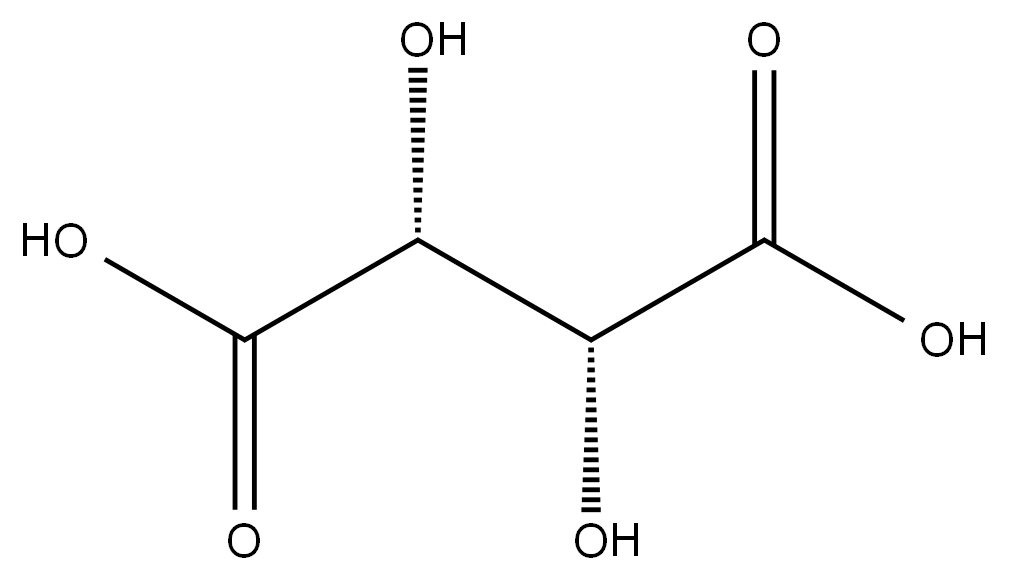
DL-Tartaric acid, also known as racemic tartaric acid, is a versatile organic compound widely utilized across various industrial sectors. Its chemical formula is C₄H₆O₆, and it carries the CAS Registry Number 133-40-8. This substance exists as a racemic mixture containing equal amounts of D-tartaric acid (L-(+)-tartaric acid) and L-tartaric acid (D-(-)-tartaric acid). Unlike its natural counterpart, which is abundant in grapes and wine production, DL-tartaric acid is typically synthesized chemically to ensure consistency and cost-effectiveness for large-scale applications.
Physically, DL-tartaric acid appears as a white crystalline powder or colorless crystals. It possesses high solubility in water and moderate solubility in ethanol, making it an ideal candidate for aqueous formulations. The compound exhibits mild acidity, with pKa values around 2.98 and 4.34, allowing it to function effectively as a buffering agent and pH regulator. Its unique molecular structure enables strong chelating properties, facilitating the removal of metal ions from solutions, which is crucial in water treatment and cleaning processes.
The primary applications of DL-tartaric acid are extensive. In the food industry, it serves as an acidity regulator, leavening agent, and antioxidant preservative, often found in beverages, jams, and baking powders. In the pharmaceutical sector, it acts as an excipient to stabilize drug formulations and control dissolution rates. Furthermore, it plays a significant role in electroplating and metallurgy as a complexing agent to improve bath stability and coating quality. The textile industry utilizes it for dye fixation and scouring agents, while the leather industry employs it for tanning processes. Additionally, DL-tartaric acid is used in the synthesis of various esters and polymers, contributing to the production of resins and plastics. Due to its non-toxic nature and biodegradability, it is considered an environmentally friendly alternative to harsher acids in many industrial protocols. Its availability as a synthetic product ensures a steady supply chain independent of agricultural harvests, supporting global manufacturing demands efficiently.







 (All Rights Reserved)