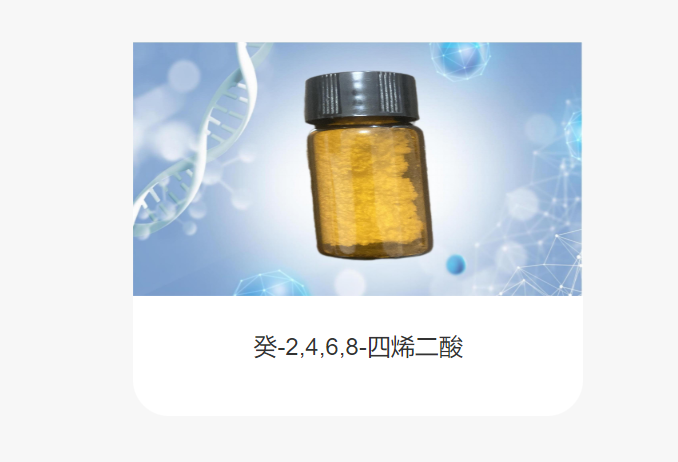
CAS号:6048-86-8英文名:DECA-2,4,6,8(E,E,E,E)-TETRAENEDIOICACID英文别名:2,4,6,8-Decatetraenedioicacid;deca-2,4,6,8-tetraenedioicacid;DECA-2,4,6,8(E,E,E,ChemicalbookE)-TETRAENEDIOICACID;(2E,4E,6E,8E)-deca-2,4,6,8-tetraenedioicAcid中文名:癸-2,4,6,8-四烯二酸中文别名:癸-2,4,6,8-四烯二酸CBNumber:CB3255908分子式:C10H10O4分子量:194.18
*The following content is generated by AI and is for reference only.
DECA-2,4,6,8(E,E,E,E)-Tetraenedioic Acid is a specialized organic compound characterized by a linear ten-carbon backbone featuring four conjugated double bonds in the trans configuration. Its systematic name reflects its structure as a derivative of decadienoic acid with specific geometric isomerism at positions 2, 4, 6, and 8. While commercial databases often list this compound under various trade names or as an intermediate in synthetic chemistry, it does not possess a widely recognized standard CAS number in major public registries like those for common commodity chemicals, suggesting it may be a custom-synthesized reagent or a specific research-grade material rather than a mass-market product. The molecular formula corresponds to C10H10O4, indicating a dicarboxylic acid structure with significant unsaturation.
This molecule finds primary application in advanced materials science and academic research contexts. Due to its extended conjugated pi-system, DECA-2,4,6,8-tetraenedioic acid serves as a valuable building block for synthesizing conductive polymers, liquid crystals, and functionalized nanomaterials. The rigid, planar geometry imparted by the all-trans double bonds allows for precise molecular packing, which is crucial when designing organic electronic components such as field-effect transistors or light-emitting diodes (OLEDs). Researchers utilize this acid as a linker in metal-organic frameworks (MOFs) to create porous structures with tailored optical properties. Furthermore, its carboxyl groups facilitate easy derivatization, enabling the attachment of fluorophores or other functional moieties for bio-imaging studies.
In industrial settings, while not a bulk commodity, this compound represents a niche solution for high-performance applications requiring specific electronic or structural characteristics. Its synthesis typically involves multi-step organic transformations, including Wittig reactions or olefin metathesis, followed by rigorous purification to ensure the desired stereochemical purity. As the demand for sustainable and efficient organic electronics grows, compounds like this play an increasingly vital role in bridging the gap between fundamental chemical theory and practical technological innovation. Users should handle this substance with appropriate safety precautions, adhering to standard protocols for handling reactive organic acids and unsaturated hydrocarbons.


![6,8-Dioxo-5,7-diazaspiro[3.4]octane-2-carboxylic acid](https://eimg.pharmasources.com/image/product/20250403/02effeb5a7639bc84ff1f3add3c0c64fjpg)
![8-Oxa-1,3-diazaspiro[4.5]decane-2,4-dione](https://eimg.pharmasources.com/image/product/20250403/60fa7223d5a34f24138486ceea0ffb15jpg)
![8,16-Diazadispiro[6.1.6.2]heptadecan-17-one](https://eimg.pharmasources.com/image/product/20250403/ca91cba8b87e53fc879f8d8764873a40jpg)



 (All Rights Reserved)