Product Description
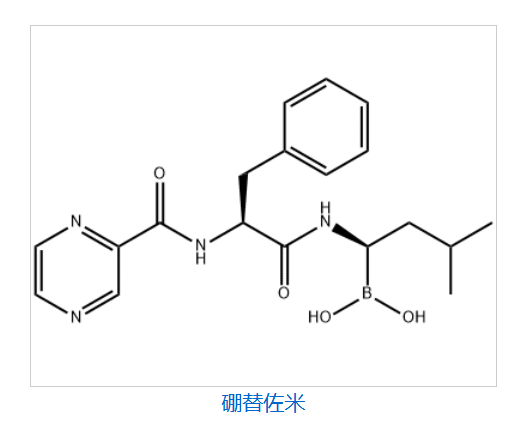
硼替佐米化学性质熔点:122-124°C密度:1.214RTECS号:ED7771666储存条件:Inertatmosphere,Storeinfreezer,under-20°C溶解度:Solubleinchloroform,diChemicalbookmethylsulfoxide,ethanolandmethanol.酸度系数(pKa):9.66±0.43(Predicted)形态:solid颜色:White稳定性:HygroscopicandMoistureSensitive
AI Product Description
*The following content is generated by AI and is for reference only.
Bortezomib, marketed under the brand name Velcade, is a potent proteasome inhibitor utilized primarily in the treatment of hematologic malignancies. Its molecular formula is C19H25BN4O6, and it is identified by the CAS number 179324-69-7. This compound features a boronic acid moiety that reversibly binds to the catalytic threonine residue within the 20S proteasome subunit, effectively blocking its chymotrypsin-like activity. By inhibiting the ubiquitin-proteasome pathway, Bortezomib prevents the degradation of pro-apoptotic proteins such as p53 and IκB, leading to an accumulation of these molecules within cancer cells. This accumulation triggers cell cycle arrest and induces programmed cell death, particularly in multiple myeloma and mantle cell lymphoma cells, which are highly dependent on proteasome function for survival.
Clinically, Bortezomib has revolutionized the therapeutic landscape for relapsed or refractory multiple myeloma, often serving as a cornerstone agent in combination regimens with dexamethasone, lenalidomide, or daratumumab. It is also approved for the first-line treatment of patients with mantle cell lymphoma who have received at least one prior therapy. The drug is administered intravenously or subcutaneously, typically in cycles, allowing for precise dosing adjustments based on patient tolerance and response. While generally well-tolerated, common adverse effects include peripheral neuropathy, fatigue, thrombocytopenia, and gastrointestinal disturbances, necessitating careful monitoring during treatment protocols.
Beyond oncology, ongoing research explores its potential in treating other solid tumors and inflammatory conditions where proteasome dysregulation plays a role. As a peptide boronate, Bortezomib represents a significant advancement in targeted cancer therapy, offering a mechanism distinct from traditional chemotherapy agents. Its unique chemical structure allows for high specificity against malignant cells while sparing normal tissue to a degree, improving overall survival rates for patients with aggressive blood cancers. Continued investigation into novel analogs aims to further enhance efficacy and reduce toxicity profiles, ensuring Bortezomib remains a critical tool in modern hematology and oncology practice.




![6,8-Dioxo-5,7-diazaspiro[3.4]octane-2-carboxylic acid](https://eimg.pharmasources.com/image/product/20250403/02effeb5a7639bc84ff1f3add3c0c64fjpg)
![8-Oxa-1,3-diazaspiro[4.5]decane-2,4-dione](https://eimg.pharmasources.com/image/product/20250403/60fa7223d5a34f24138486ceea0ffb15jpg)

![8,16-Diazadispiro[6.1.6.2]heptadecan-17-one](https://eimg.pharmasources.com/image/product/20250403/ca91cba8b87e53fc879f8d8764873a40jpg)





 (All Rights Reserved)