Category:
Other Specialized Reagents
CAS NO:
100-46-9
Standard:
ChP,In-house Standards,


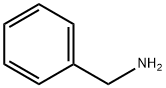

Benzylamine, also known as benzylamine α- Aminotoluene, horseradish alkaloids. Colorless liquid. Produce smoke in the air. Boiling point 185 ℃, 90 ℃ (1600Pa), relative density 0.9813, refractive index 1.5401, UV λ Max255, 262, 270nm. Miscible with water, ethanol, and ether, soluble in acetone and benzene. At 25 ℃, K=2.4 × 10⁻⁵, showing alkaline reaction. Absorbable CO2, Chemicalbook reacts with halogenated hydrocarbons to form N-substituted benzylamines, reacts with acyl chlorides, anhydrides or esters to form N-benzylamides, and reacts with aldehydes and ketones to form N-benzylimines. Preparation method: It can be obtained by the reaction of benzyl chloride with ammonia, or by the reduction of benzonitrile, or by the reduction and amination of benzaldehyde with NH3 and H2/Ni. Usage: Used for organic synthesis, qualitative testing of metal organic compounds, determination of platinum, vanadium, and tungstate salts, and as a precipitant for thorium, cerium, lanthanum, zirconium, etc.



 (All Rights Reserved) (All Rights Reserved)




![8-Oxa-1,3-diazaspiro[4.5]decane-2,4-dione](https://eimg.pharmasources.com/image/product/20250403/60fa7223d5a34f24138486ceea0ffb15jpg)
![6,8-Dioxo-5,7-diazaspiro[3.4]octane-2-carboxylic acid](https://eimg.pharmasources.com/image/product/20250403/02effeb5a7639bc84ff1f3add3c0c64fjpg)
![8,16-Diazadispiro[6.1.6.2]heptadecan-17-one](https://eimg.pharmasources.com/image/product/20250403/ca91cba8b87e53fc879f8d8764873a40jpg)