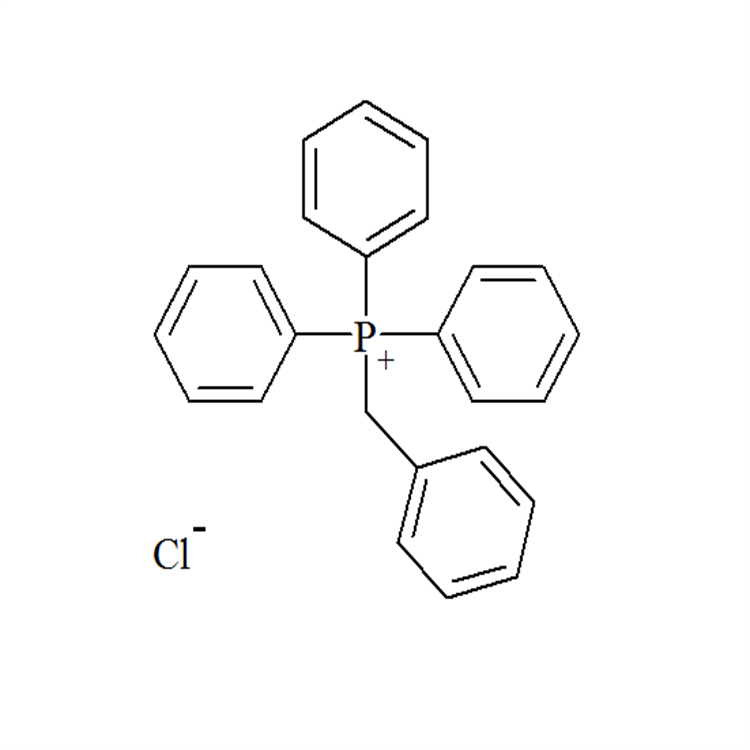
Product Name: Benzyl triphenyl phosphonium chloride
CAS number: 1100-88-5
Molecular formula: C25H22PCl
Molecular weight: 388.87
Purity (content): 98%
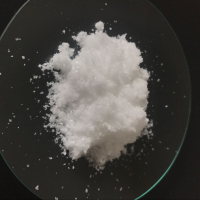
Property: White to off white solid.
Usage: Used as a phase transfer catalyst.
Caution: Easy to absorb water, should be sealed and stored dry.
*The following content is generated by AI and is for reference only.
Benzyl triphenylphosphonium chloride is a versatile quaternary phosphonium salt widely utilized in organic synthesis and pharmaceutical research. Its molecular formula is C₂₅H₂₂ClP, and it carries the CAS Registry Number 1457-63-8. This compound appears as a white to off-white crystalline powder, which is generally stable under standard laboratory conditions but sensitive to strong oxidizing agents. The substance plays a pivotal role as a precursor for generating ylides, specifically through deprotonation with strong bases such as sodium hydride or n-butyllithium.
The primary application of benzyl triphenylphosphonium chloride lies in the Wittig reaction, a cornerstone method for synthesizing alkenes from carbonyl compounds. When treated with a base, it forms benzylidenetriphenylphosphorane, an ylide that reacts efficiently with aldehydes and ketones to produce terminal olefins with high stereoselectivity. This transformation is indispensable in the construction of complex carbon skeletons found in natural products, agrochemicals, and fine chemicals. Beyond the Wittig reaction, this salt serves as a phase-transfer catalyst in certain nucleophilic substitution reactions, facilitating the transfer of anions into organic phases where they can react more effectively.
In the pharmaceutical industry, intermediates derived from this reagent are used in the synthesis of various bioactive molecules, including anti-cancer agents and antiviral drugs. Its utility extends to materials science, where it aids in the preparation of functionalized polymers and specialized ligands for transition metal catalysis. The commercial availability of this reagent makes it a staple in academic laboratories and industrial R&D departments globally. While handling requires standard safety precautions due to potential irritant properties, its reliability and cost-effectiveness ensure its continued prominence in synthetic chemistry. Researchers appreciate its predictable reactivity profile, which allows for precise control over double bond formation, making it an essential tool for chemists aiming to construct specific alkene geometries with minimal side products.





 (All Rights Reserved)
![6,8-Dioxo-5,7-diazaspiro[3.4]octane-2-carboxylic acid](https://eimg.pharmasources.com/image/product/20250403/02effeb5a7639bc84ff1f3add3c0c64fjpg)
![8-Oxa-1,3-diazaspiro[4.5]decane-2,4-dione](https://eimg.pharmasources.com/image/product/20250403/60fa7223d5a34f24138486ceea0ffb15jpg)
![8,16-Diazadispiro[6.1.6.2]heptadecan-17-one](https://eimg.pharmasources.com/image/product/20250403/ca91cba8b87e53fc879f8d8764873a40jpg)