Product Description
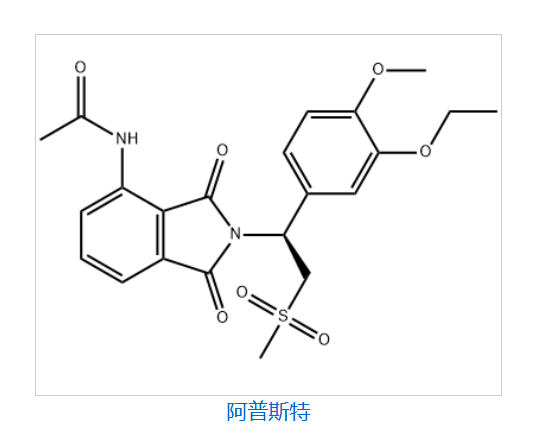
阿普斯特化学性质熔点:152-156°C沸点:741.3±60.0°C(Predicted)密度:1.381储存条件:Refrigerator溶解度:Chloroform(Slightly),DMSO(Slightly),Methanol(Slightly,Heated)酸度系数(pKa):14.01±0.2Chemicalbook0(Predicted)形态:Solid颜色:WhitetoPaleYellowInChIKey:IMOZEMNVLZVGJZ-QGZVFWFLSA-NSMILES:C(NC1=CC=CC2=C1C(=O)N([C@@H](C1=CC=C(OC)C(OCC)=C1)CS(C)(=O)=O)C2=O)(=O)C
AI Product Description
*The following content is generated by AI and is for reference only.
Apremilast, marketed under the brand name Otezla, is a potent oral phosphodiesterase 4 (PDE4) inhibitor developed for the treatment of moderate to severe plaque psoriasis in adults and active psoriatic arthritis. Its unique mechanism of action involves selectively inhibiting PDE4, an enzyme responsible for breaking down cyclic adenosine monophosphate (cAMP). By blocking this degradation, Apremilast increases intracellular cAMP levels within immune cells, leading to a downstream reduction in pro-inflammatory cytokines such as tumor necrosis factor-alpha (TNF-α), interleukin-17 (IL-17), and interferon-gamma. This modulation helps restore immune balance without causing broad immunosuppression, distinguishing it from traditional systemic therapies like methotrexate or biologics that target specific immune pathways directly.
The chemical identity of Apremilast is defined by its molecular formula, C20H23NO6S, and its CAS registry number, 849152-07-8. Structurally, it features a complex arrangement including a pyridine ring, a sulfone group, and various chiral centers, which are critical for its high affinity and selectivity toward the PDE4 enzyme. The drug is administered orally as tablets, offering patients a convenient alternative to injectable treatments. Clinical trials have demonstrated significant improvements in skin clearance scores and reduction in joint symptoms for patients with psoriatic arthritis who have had inadequate responses to other therapies.
Common side effects include diarrhea, nausea, headache, and upper respiratory tract infections. While generally well-tolerated, clinicians monitor for potential weight loss and psychiatric events, including depression and suicidal ideation, although these risks remain relatively low compared to other immunomodulators. Apremilast represents a significant advancement in dermatology and rheumatology, providing a targeted, non-biologic option that improves quality of life for millions suffering from chronic inflammatory conditions. Its approval has expanded therapeutic landscapes, offering hope to patients seeking effective management with a favorable safety profile relative to conventional systemic agents.


![8,16-Diazadispiro[6.1.6.2]heptadecan-17-one](https://eimg.pharmasources.com/image/product/20250403/ca91cba8b87e53fc879f8d8764873a40jpg)
![8-Oxa-1,3-diazaspiro[4.5]decane-2,4-dione](https://eimg.pharmasources.com/image/product/20250403/60fa7223d5a34f24138486ceea0ffb15jpg)
![6,8-Dioxo-5,7-diazaspiro[3.4]octane-2-carboxylic acid](https://eimg.pharmasources.com/image/product/20250403/02effeb5a7639bc84ff1f3add3c0c64fjpg)



 (All Rights Reserved)