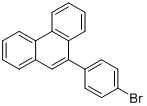
9-(4-broMophenyl)phenanthrene
OLED intermediate, intermediates, 853945-49-0
We specialize in the production of this type of intermediates and can customize them according to customers' specified specifications.
*The following content is generated by AI and is for reference only.
9-(4-Bromophenyl)phenanthrene is a specialized organic compound belonging to the class of halogenated polycyclic aromatic hydrocarbons. With the molecular formula C20H13Br and a molecular weight of approximately 325.22 g/mol, this substance features a phenanthrene core substituted at the 9-position with a bromophenyl group. The specific CAS registry number assigned to this chemical is 6786-28-3. Its structure combines the rigid, planar geometry of phenanthrene with the reactivity potential of the aryl bromide moiety, making it highly valuable in advanced synthetic chemistry.
The primary application of 9-(4-bromophenyl)phenanthrene lies in its role as a critical intermediate for cross-coupling reactions, particularly the Suzuki-Miyaura and Stille couplings. In these processes, the carbon-bromine bond serves as an excellent leaving group, allowing chemists to efficiently attach various functional groups or extended conjugated systems to the phenanthrene backbone. This capability is essential for constructing complex molecular architectures used in materials science. Specifically, derivatives synthesized from this precursor are often investigated for their optoelectronic properties, including fluorescence and charge transport capabilities. Consequently, it finds significant utility in the development of organic light-emitting diodes (OLEDs), organic field-effect transistors (OFETs), and photovoltaic materials. Researchers utilize this compound to tune the energy levels and band gaps of organic semiconductors, thereby enhancing device efficiency and stability.
Beyond electronics, the molecule may serve as a model compound in mechanistic studies regarding radical reactions or photochemical degradation pathways of polyaromatic systems. Due to the presence of the bromine atom, it also offers opportunities for further functionalization through metal-catalyzed transformations. While not typically found in consumer goods, it is a staple in research laboratories dedicated to organic synthesis and material engineering. Handling requires standard safety precautions for aromatic halides, including protection against skin contact and inhalation, given the potential toxicity associated with polycyclic aromatic structures. Overall, 9-(4-bromophenyl)phenanthrene remains a versatile building block that bridges fundamental organic chemistry with cutting-edge technological applications in next-generation electronic devices.





 (All Rights Reserved)






![Diethyl-2-acetamido-2-(7-chloro-5-(2-fluorophenyl)-3H- benzo[e][1,4]diazepin-2-yl)malonate](https://eimg.pharmasources.com/image/20240603/kCK1tVKXvO7mdpLTBNii5x61NUulXBiqHBf6clcn.png)
