Product Description
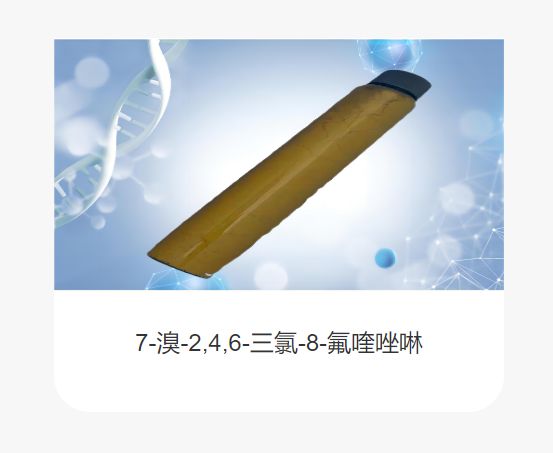
7-溴-2,4,6-三氯-8-氟喹唑啉化学性质 沸点: 351.8±42.0 °C(Predicted) 密度: 1.987±0.06 g/cm3(Predicted)
AI Product Description
*The following content is generated by AI and is for reference only.
7-Bromo-2,4,6-trichloro-8-fluoroquinazoline is a highly functionalized heterocyclic compound belonging to the quinazoline family, widely recognized in medicinal chemistry and organic synthesis as a versatile building block. Its molecular formula is C8HBrCl3FN4, with a molecular weight of approximately 351.38 g/mol. The Compound is characterized by a quinazoline core substituted with three chlorine atoms at positions 2, 4, and 6, a fluorine atom at position 8, and a bromine atom at position 7. This specific substitution pattern renders the molecule exceptionally reactive toward nucleophilic aromatic substitution (SnAr) reactions, particularly at the C2, C4, and C6 positions, making it an ideal scaffold for constructing complex pharmaceutical intermediates.
The primary application of this chemical lies in the development of kinase inhibitors and other bioactive agents. Quinazoline derivatives are well-documented for their potent biological activities, including anti-cancer, anti-inflammatory, and antimicrobial properties. By leveraging the high electrophilicity of the chlorinated carbons, researchers can efficiently introduce various amine or thiol nucleophiles to generate diverse analogs tailored for specific therapeutic targets. For instance, modifications at the C4 or C6 positions often yield compounds with improved binding affinity to ATP-binding pockets in protein kinases, which are crucial in cancer signal transduction pathways. Furthermore, the presence of the fluorine atom can enhance metabolic stability and lipophilicity, while the bromine substituent offers a strategic handle for further cross-coupling reactions, such as Suzuki-Miyaura or Heck couplings, allowing for the rapid expansion of the chemical library.
Currently, this compound is primarily utilized by academic research institutions and pharmaceutical companies during the early stages of drug discovery and lead optimization. It serves as a critical precursor for synthesizing novel heterocyclic systems that may address unmet medical needs. Due to its reactivity and specific halogenation profile, careful handling and storage under inert atmospheres are recommended to maintain purity and prevent premature hydrolysis. While not yet a common commercial commodity for general industrial use, its role in advancing small-molecule therapeutics remains significant within the global chemical supply chain dedicated to life sciences.


![6,8-Dioxo-5,7-diazaspiro[3.4]octane-2-carboxylic acid](https://eimg.pharmasources.com/image/product/20250403/02effeb5a7639bc84ff1f3add3c0c64fjpg)
![8-Oxa-1,3-diazaspiro[4.5]decane-2,4-dione](https://eimg.pharmasources.com/image/product/20250403/60fa7223d5a34f24138486ceea0ffb15jpg)
![8,16-Diazadispiro[6.1.6.2]heptadecan-17-one](https://eimg.pharmasources.com/image/product/20250403/ca91cba8b87e53fc879f8d8764873a40jpg)



 (All Rights Reserved)