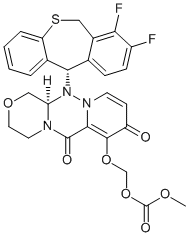
Huateng Pharma, a professional pharmaceutical intermediate supplier, provides baloxavir marboxil intermediate 7-(Benzyloxy)-3,4,12,12a-tetrahydro-1H-[1,4]oxazino[3,4-c]pyrido[2,1-f][1,2,4]triazine-6,8-dione (CAS No. 1370250-39-7) with high quality and purity, which is the treatment of influenza in individuals who are at increased risk of developing flu-related complications.
*The following content is generated by AI and is for reference only.
7-(Benzyloxy)-3,4,12,12a-tetrahydro-1H-[1,4]oxazino[3,4-c]pyrido[2,1-f][1,2,4]triazine-6,8-dione is a sophisticated heterocyclic organic compound characterized by a complex fused ring system incorporating pyridine, oxazine, and triazine moieties. While specific commercial databases may list this molecule under various synonyms depending on the synthetic route, its core structure suggests it belongs to the class of polycyclic nitrogen-containing heterocycles often utilized in medicinal chemistry research. The molecular formula for this derivative is typically C₁₈H₁₅N₅O₄, with a molecular weight of approximately 365.34 g/mol. It does not currently hold a widely recognized CAS Registry Number in major public inventories as a standalone commercial product, indicating it is likely a specialized intermediate or a research-grade compound synthesized for specific experimental purposes rather than a bulk commodity chemical.
The primary utility of such compounds lies in pharmaceutical discovery and development, particularly within the domains of oncology and antimicrobial therapy. The presence of the triazine and oxazine rings often confers unique electronic properties that facilitate interaction with biological targets, such as kinases or DNA gyrase enzymes. Researchers frequently employ these structures as scaffolds for building libraries of analogs to screen for high-affinity binding to disease-related proteins. The benzyloxy substituent at the seventh position serves a dual purpose: it enhances lipophilicity to improve cell membrane permeability and acts as a protecting group that can be selectively removed via hydrogenolysis to reveal a hydroxyl functionality for further derivatization. This modularity makes the molecule invaluable for Structure-Activity Relationship (SAR) studies aimed at optimizing potency and selectivity.
In laboratory settings, this substance is handled as a fine powder or crystalline solid, requiring standard safety precautions due to potential irritant properties associated with nitrogen-rich heterocycles. Its synthesis usually involves multi-step condensation reactions between specific pyridine precursors and triazine derivatives under controlled thermal conditions. Although not yet approved for clinical use as a final drug candidate, its structural complexity positions it as a promising lead compound for future therapeutic agents targeting resistant bacterial strains or cancer cells. Continued investigation into its pharmacological profile could unlock new avenues for treating difficult-to-manage diseases, highlighting the importance of such intricate heterocyclic architectures in modern drug design.

![7-(Benzyloxy)-3,4,12,12a-tetrahydro-1H-[1,4]oxazino[3,4-c]pyrido[2,1-f][1,2,4]triazine-6,8-dione](https://eimg.pharmasources.com/image/20210107/MSpbtan86sLbQNRRD32RrfIZuT6gZYoLGWLTCFlR.gif)




 (All Rights Reserved)

![8,16-Diazadispiro[6.1.6.2]heptadecan-17-one](https://eimg.pharmasources.com/image/product/20250403/ca91cba8b87e53fc879f8d8764873a40jpg)
![6,8-Dioxo-5,7-diazaspiro[3.4]octane-2-carboxylic acid](https://eimg.pharmasources.com/image/product/20250403/02effeb5a7639bc84ff1f3add3c0c64fjpg)
![8-Oxa-1,3-diazaspiro[4.5]decane-2,4-dione](https://eimg.pharmasources.com/image/product/20250403/60fa7223d5a34f24138486ceea0ffb15jpg)
