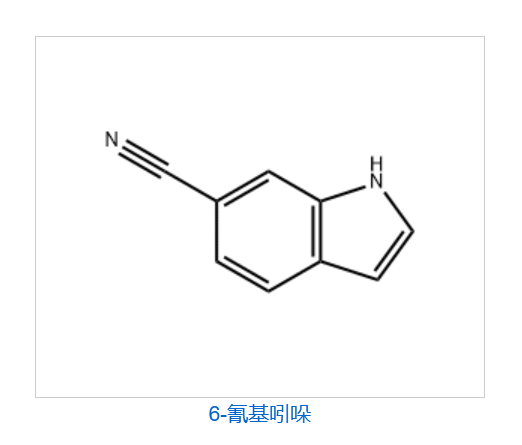
6-氰基吲哚化学性质熔点:130-132°C沸点:350.0±15.0°C(Predicted)密度:1.24±0.1g/cm3(Predicted)储存条件:Keepindarkplace,IChemicalbooknertatmosphere,Roomtemperature溶解度:Dichloromethane,Methanol酸度系数(pKa):15.17±0.30(Predicted)形态:Solid
*The following content is generated by AI and is for reference only.
6-Cyanoindole is a specialized organic intermediate widely utilized in the fields of pharmaceutical chemistry, agrochemical research, and materials science. With the chemical formula C9H6N2 and a molecular weight of approximately 146.16 g/mol, this compound serves as a crucial building block for synthesizing complex heterocyclic structures. Its primary commercial identifier is CAS number 3875-03-8, which ensures precise identification across global supply chains and regulatory databases.
The core utility of 6-cyanoindole lies in its versatile reactivity profile. The cyano group positioned at the sixth carbon of the indole ring acts as an excellent electrophilic site, allowing chemists to perform various nucleophilic substitutions or reduction reactions to introduce diverse functional groups. This structural feature makes it indispensable in the synthesis of bioactive molecules, particularly those containing indole scaffolds found in numerous alkaloids and natural products. In the pharmaceutical industry, derivatives of 6-cyanoindole are explored for potential applications in treating neurological disorders, inflammation, and cancer due to their ability to interact with specific biological receptors.
Furthermore, this compound plays a significant role in agrochemical development. It serves as a precursor for designing novel herbicides and fungicides that target specific plant pathogens while maintaining environmental safety profiles. The high purity grade available commercially often exceeds 98%, ensuring reliability in sensitive synthetic pathways where trace impurities could compromise yield or biological activity. Researchers frequently employ 6-cyanoindole in multi-step organic syntheses to construct advanced drug candidates, leveraging its stability under standard laboratory conditions.
Beyond medicinal and agricultural sectors, 6-cyanoindole finds niche applications in the development of fluorescent probes and optoelectronic materials. Its conjugated pi-system contributes to unique optical properties useful in sensing technologies. As a key commodity in fine chemical manufacturing, it bridges the gap between basic aromatic compounds and highly sophisticated therapeutic agents. Continuous demand from R&D departments drives innovation in its production methods, emphasizing efficiency and sustainability. Ultimately, 6-cyanoindole remains a foundational molecule for advancing scientific discovery across multiple disciplines, offering a robust platform for creating next-generation functional materials and life-saving medicines.


![6,8-Dioxo-5,7-diazaspiro[3.4]octane-2-carboxylic acid](https://eimg.pharmasources.com/image/product/20250403/02effeb5a7639bc84ff1f3add3c0c64fjpg)
![8-Oxa-1,3-diazaspiro[4.5]decane-2,4-dione](https://eimg.pharmasources.com/image/product/20250403/60fa7223d5a34f24138486ceea0ffb15jpg)
![8,16-Diazadispiro[6.1.6.2]heptadecan-17-one](https://eimg.pharmasources.com/image/product/20250403/ca91cba8b87e53fc879f8d8764873a40jpg)



 (All Rights Reserved)