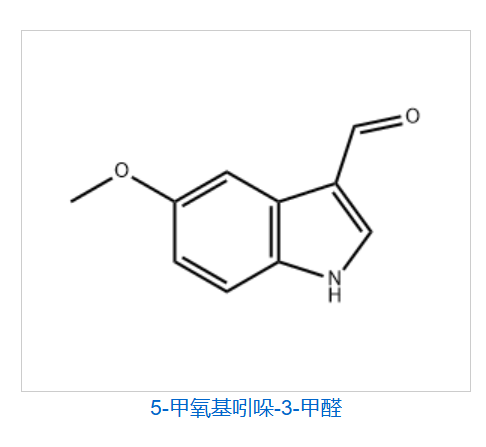
5-甲氧基吲哚-3-甲醛化学性质熔点:179-183°C(lit.)沸点:306.47°C(roughestimate)密度:1.1999(roughestimate)折射率:1.5060(estimate)储存条件:KeepindarkplChemicalbookace,Sealedindry,RoomTemperature形态:CrystallinePowderorNeedles酸度系数(pKa):15.21±0.30(Predicted)颜色:Yellowtobeige水溶解性:insoluble
*The following content is generated by AI and is for reference only.
5-Methoxyindole-3-carboxaldehyde is a specialized organic compound widely recognized in medicinal chemistry and materials science for its versatile synthetic utility. With the molecular formula C11H9NO2 and a CAS Registry Number of 10478-67-0, this aldehyde derivative features an indole core substituted with a methoxy group at the fifth position and an aldehyde functionality at the third carbon. This specific structural arrangement imparts unique reactivity patterns, making it an invaluable building block for constructing complex heterocyclic architectures.
In pharmaceutical research, this compound serves as a critical precursor for synthesizing bioactive molecules, including potential anticancer agents, anti-inflammatory drugs, and neuroprotective compounds. The indole scaffold is ubiquitous in nature, found in alkaloids like serotonin and tryptophan, while the aldehyde group allows for facile condensation reactions such as Knoevenagel condensations or Wittig olefinations. These transformations enable chemists to rapidly generate diverse libraries of indole-based derivatives for high-throughput screening. Furthermore, the methoxy substituent can modulate electronic properties and lipophilicity, optimizing the pharmacokinetic profiles of final drug candidates.
Beyond medicine, 5-methoxyindole-3-carboxaldehyde finds applications in the development of functional organic materials. It is utilized in the synthesis of fluorescent dyes and optoelectronic materials due to the conjugated pi-system inherent in the indole ring. Its ability to participate in cyclization reactions facilitates the creation of fused polycyclic systems used in organic light-emitting diodes (OLEDs) and sensors. Additionally, researchers employ this aldehyde in the study of reaction mechanisms involving electrophilic aromatic substitution and nucleophilic addition, providing insights into fundamental organic chemistry principles.
The compound is typically supplied as a white to off-white crystalline powder, requiring storage under inert atmosphere and cool conditions to prevent oxidation or polymerization. While primarily a laboratory reagent, its role extends to academic investigations into structure-activity relationships (SAR). As the demand for novel heterocyclic scaffolds grows in both therapeutic and technological sectors, 5-methoxyindole-3-carboxaldehyde remains a pivotal tool for advancing chemical innovation and material design globally.


![8-Oxa-1,3-diazaspiro[4.5]decane-2,4-dione](https://eimg.pharmasources.com/image/product/20250403/60fa7223d5a34f24138486ceea0ffb15jpg)
![6,8-Dioxo-5,7-diazaspiro[3.4]octane-2-carboxylic acid](https://eimg.pharmasources.com/image/product/20250403/02effeb5a7639bc84ff1f3add3c0c64fjpg)
![8,16-Diazadispiro[6.1.6.2]heptadecan-17-one](https://eimg.pharmasources.com/image/product/20250403/ca91cba8b87e53fc879f8d8764873a40jpg)



 (All Rights Reserved)