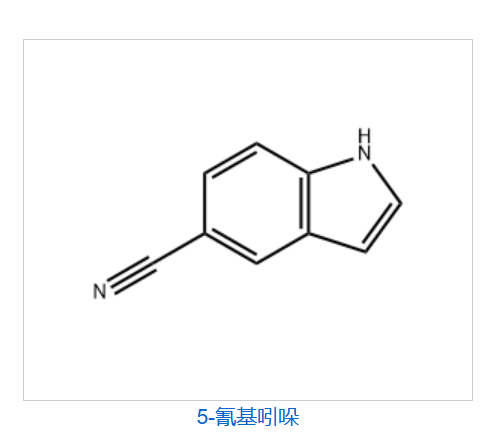
5-氰基吲哚化学性质熔点:106-108°C(lit.)沸点:249.72°C(roughestimate)密度:1.1777(roughestimate)折射率:1.6211(estimate)储存条件:Keepindarkplace,InertatmChemicalbookosphere,Roomtemperature溶解度:Chloroform,Hexane,Methanol酸度系数(pKa):15.62±0.30(Predicted)形态:CrystallinePowder颜色:Whitetoslightlyyellow
*The following content is generated by AI and is for reference only.
5-Cyanoindole, chemically known as 1H-indole-5-carbonitrile, is a versatile heterocyclic intermediate widely utilized in the fields of pharmaceutical research and organic synthesis. With the molecular formula C9H6N2 and a CAS registry number of 38704-34-2, this compound features an indole core substituted with a cyano group at the fifth position. The presence of both the electron-rich indole ring and the electrophilic nitrile functionality makes it an exceptionally valuable building block for constructing complex nitrogen-containing architectures.
In medicinal chemistry, 5-cyanoindole serves as a critical precursor for synthesizing bioactive compounds, including potential anti-inflammatory agents, anticonvulsants, and serotonin receptor modulators. The cyano group can be readily transformed into various functional groups such as amides, carboxylic acids, or tetrazoles through standard chemical reactions like hydrolysis, reduction, or cycloaddition. This synthetic flexibility allows researchers to rapidly generate diverse analogs for structure-activity relationship (SAR) studies during drug discovery pipelines. Furthermore, derivatives of 5-cyanoindole are increasingly explored in the development of fluorescent probes and materials science applications due to their unique electronic properties and fluorescence characteristics.
Commercially available as a high-purity white to off-white crystalline powder, 5-cyanoindole is typically stored under inert atmospheres to prevent degradation. It finds specific application in the manufacturing of agrochemicals, where indole-based structures play roles in plant growth regulation and pest control. As a key scaffold in modern organic synthesis, it bridges the gap between simple aromatic precursors and advanced therapeutic molecules. Its stability under standard laboratory conditions ensures reliable performance in multi-step synthesis protocols. Whether used in academic laboratories for mechanistic studies or in industrial settings for scale-up production, 5-cyanoindole remains an indispensable reagent. Researchers value its accessibility and reactivity profile, which facilitate the efficient construction of indole-fused heterocycles essential for next-generation therapeutics. Consequently, maintaining a steady supply of this compound is vital for advancing innovations in chemical biology and pharmacology globally.


![8,16-Diazadispiro[6.1.6.2]heptadecan-17-one](https://eimg.pharmasources.com/image/product/20250403/ca91cba8b87e53fc879f8d8764873a40jpg)
![8-Oxa-1,3-diazaspiro[4.5]decane-2,4-dione](https://eimg.pharmasources.com/image/product/20250403/60fa7223d5a34f24138486ceea0ffb15jpg)
![6,8-Dioxo-5,7-diazaspiro[3.4]octane-2-carboxylic acid](https://eimg.pharmasources.com/image/product/20250403/02effeb5a7639bc84ff1f3add3c0c64fjpg)



 (All Rights Reserved)