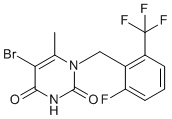
5-Bromo-1-(2-fluoro-6-(trifluoromethyl)benzyl)-6-methylpyrimidine-2,4(1H,3H)-dione CAS No. 830346-48-0 is an intermediate in the synthesis of Elagolix, a gonadotropin-releasing hormone antagonist (GnRH) used in the treatment of endometriosis.
*The following content is generated by AI and is for reference only.
5-Bromo-1-(2-fluoro-6-(trifluoromethyl)benzyl)-6-methylpyrimidine-2,4(1H,3H)-dione is a specialized heterocyclic organic compound belonging to the class of substituted uracil derivatives. With a molecular formula of C13H8BrF4N2O2 and a precise molecular weight of approximately 397.07 g/mol, this molecule features a complex structural architecture that combines a pyrimidine-2,4-dione core with distinct halogenated substituents. The presence of a bromine atom at the 5-position, a methyl group at the 6-position, and a unique 2-fluoro-6-(trifluoromethyl)benzyl moiety attached to the nitrogen atom at position 1 significantly enhances its lipophilicity and metabolic stability compared to unsubstituted analogs. While specific commercial catalog numbers may vary by supplier, the chemical identity is defined by its unique substitution pattern which is critical for structure-activity relationship (SAR) studies in medicinal chemistry.
The primary application of this compound lies within pharmaceutical research and development, particularly as a potential intermediate or lead candidate in the discovery of novel bioactive agents. Pyrimidine diones are well-known scaffolds in drug design, frequently associated with central nervous system activity, including sedative, hypnotic, and anxiolytic properties, although the specific profile of this highly functionalized derivative requires rigorous biological evaluation. The fluorinated benzyl group suggests potential utility in optimizing binding affinity to specific enzyme active sites or receptor pockets where hydrophobic interactions and electronic effects are paramount. Researchers utilize such halogenated uracil derivatives to explore mechanisms of action related to nucleotide metabolism inhibition or to develop targeted therapeutics for oncology and neurodegenerative disorders. Due to its complexity and specific halogen content, this substance is primarily handled in controlled laboratory environments for synthetic optimization rather than as a standalone consumer product. Its synthesis typically involves the alkylation of a brominated methyluracil precursor followed by careful purification to ensure high purity for downstream biological assays. As a niche chemical entity, it serves as a vital tool for chemists aiming to expand the chemical space of pyrimidine-based drugs, offering insights into how heavy halogens influence pharmacokinetic profiles and receptor selectivity in modern drug discovery pipelines.





 (All Rights Reserved)

![8-Oxa-1,3-diazaspiro[4.5]decane-2,4-dione](https://eimg.pharmasources.com/image/product/20250403/60fa7223d5a34f24138486ceea0ffb15jpg)
![6,8-Dioxo-5,7-diazaspiro[3.4]octane-2-carboxylic acid](https://eimg.pharmasources.com/image/product/20250403/02effeb5a7639bc84ff1f3add3c0c64fjpg)
![8,16-Diazadispiro[6.1.6.2]heptadecan-17-one](https://eimg.pharmasources.com/image/product/20250403/ca91cba8b87e53fc879f8d8764873a40jpg)